

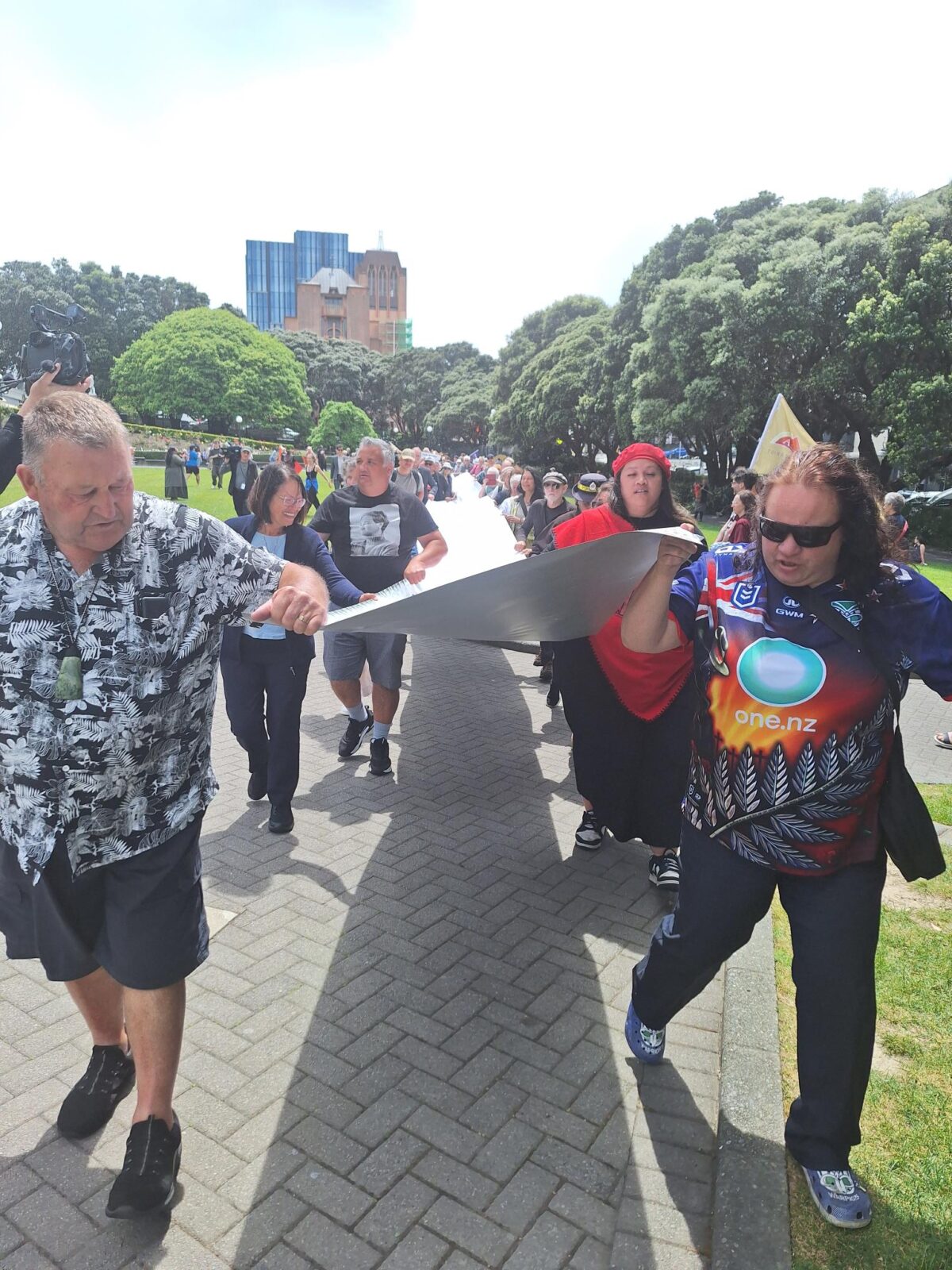
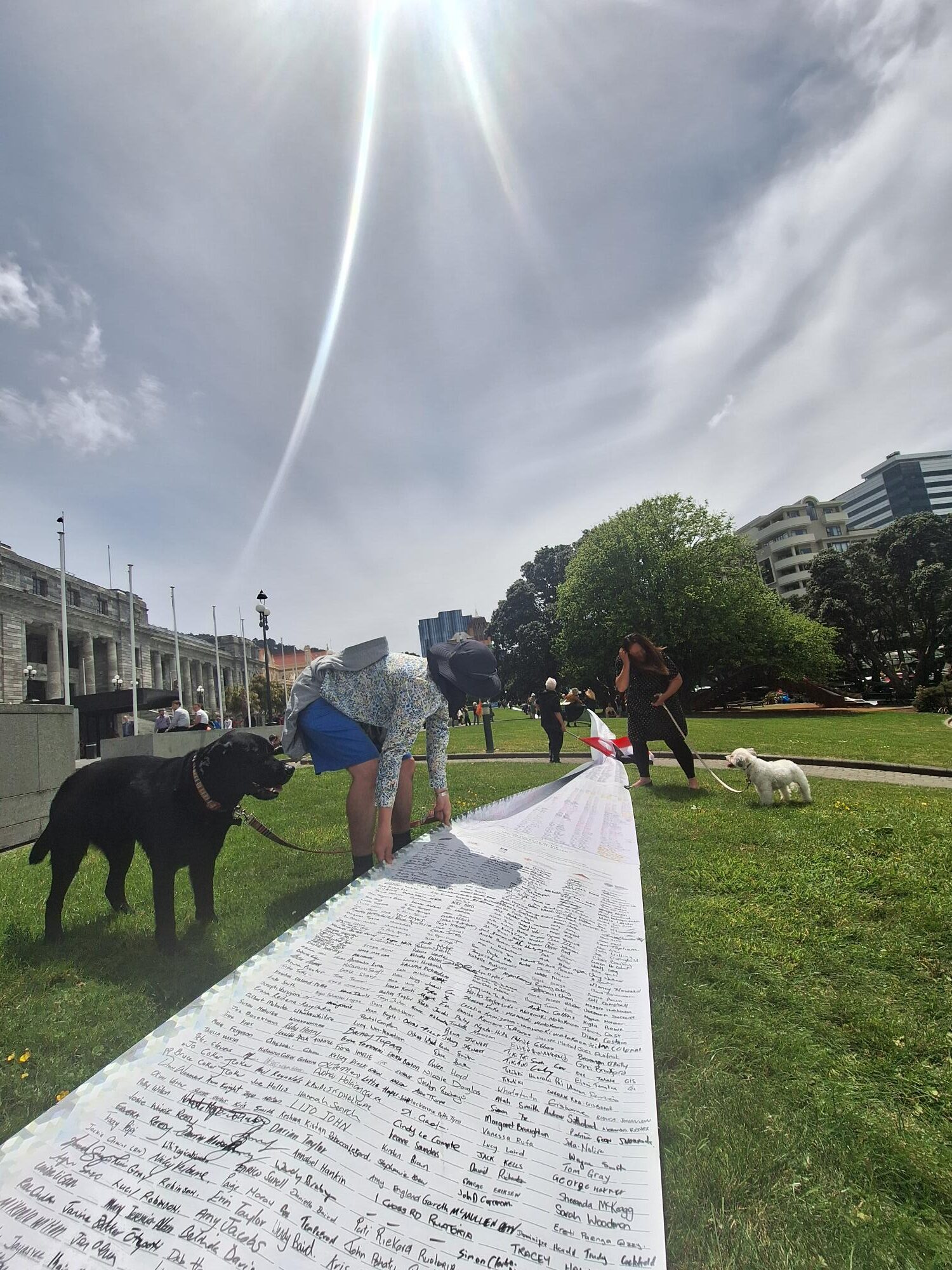
The Buller Declaration has been unrolled on Parliament’s front yard — sending a 276-meter long, 200-kilogram message to its occupants.
On Tuesday, health advocate Malcolm Mulholland delivered the petition, gathered with support from NZNO, to Parliament. He and supporters carried the scroll on a stainless steel roller up the front path, straining with the weight.
“Harikoa te ngākau ināianei,” Mulholland said [My heart is happy]. “We made it.”
The declaration said the health system was in a state of crisis, and called on the Government to allocate the resources needed to fix it.

It got its first signature on September 28 last year in Buller and has since toured the country —now that number had reached 95,000, he said.
“And that is officially the world’s longest petition ever. To be precise, 276 meters, and we felt every inch of those meters walking up that hill.”
Touring the country they started hearing it wasn’t just a Buller problem — it was a rural problem, and a Māori and Pasifika problem, Mulholland said. “Truth is, it’s everyone’s problem.”
It was the people’s petition, he said to the gathered politicians. “They’re giving you a message loud and clear.” That message was to all of them — “be they blue or red”, he said.

Mulholland founded charity Patient Voice Aotearoa in 2019 after his wife Wiki Mulholland was diagnosed with advanced breast cancer. She died aged 43 in 2021.
Making a special trip north
NZNO members have helped along the way — with the likes of southern delegates setting up a stall at the region’s biggest craft market to gather signatures in July.
Some of those nursing signature-gatherers had travelled from Invercargill to join the ceremony.
Southern delegate Charleen Waddell said she and fellow delegate Maike Rickertsen had come to tautoko the kaupapa — which dovetailed with the partial strike they were currently part of.
“[We’re] Making sure the Government takes action — we’ve got strike action in our wards, that ability to stand tall, not to take the overtime, not to be rediverted, because that happens on a daily basis.”
Rickertsen said the strike highlighted that the work they were refusing to take on was “exactly what keeps the health system going”.
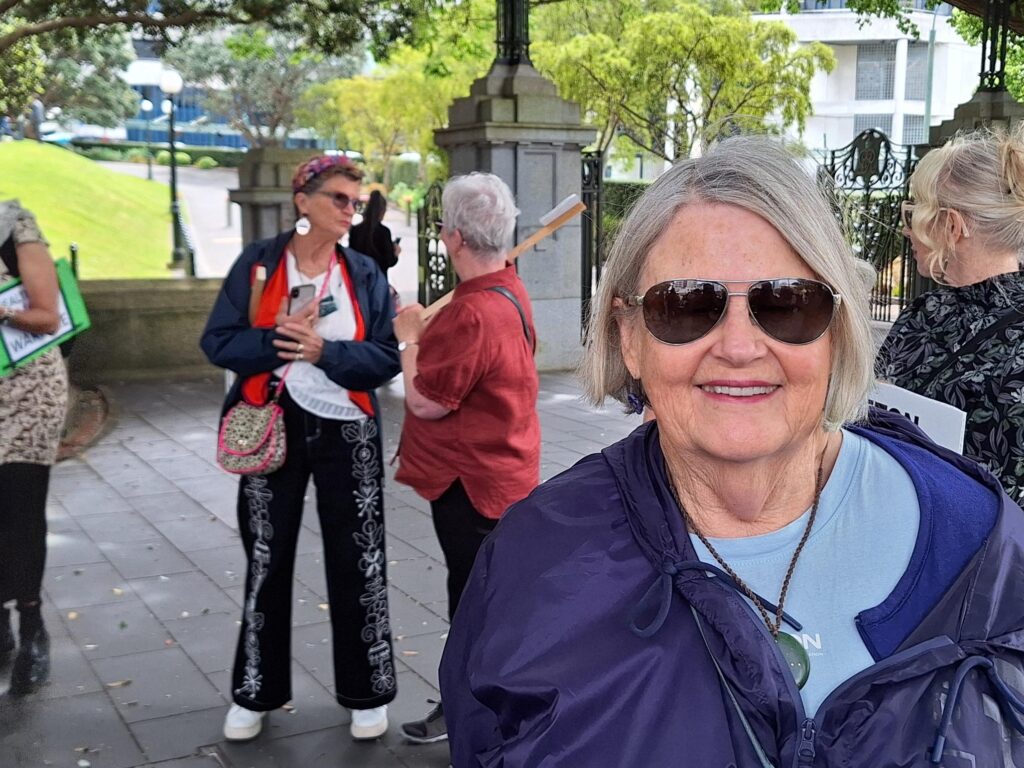
Meanwhile, for 43 years Susan Lennox, a former NZNO member, worked as a midwife in a close-knit Hutt community. She had seen her mothers for years after they’d had their babies, and watched their babies grow into adults.
Even though she retired in 2016, she was supporting the declaration at the handover, said Lennox.
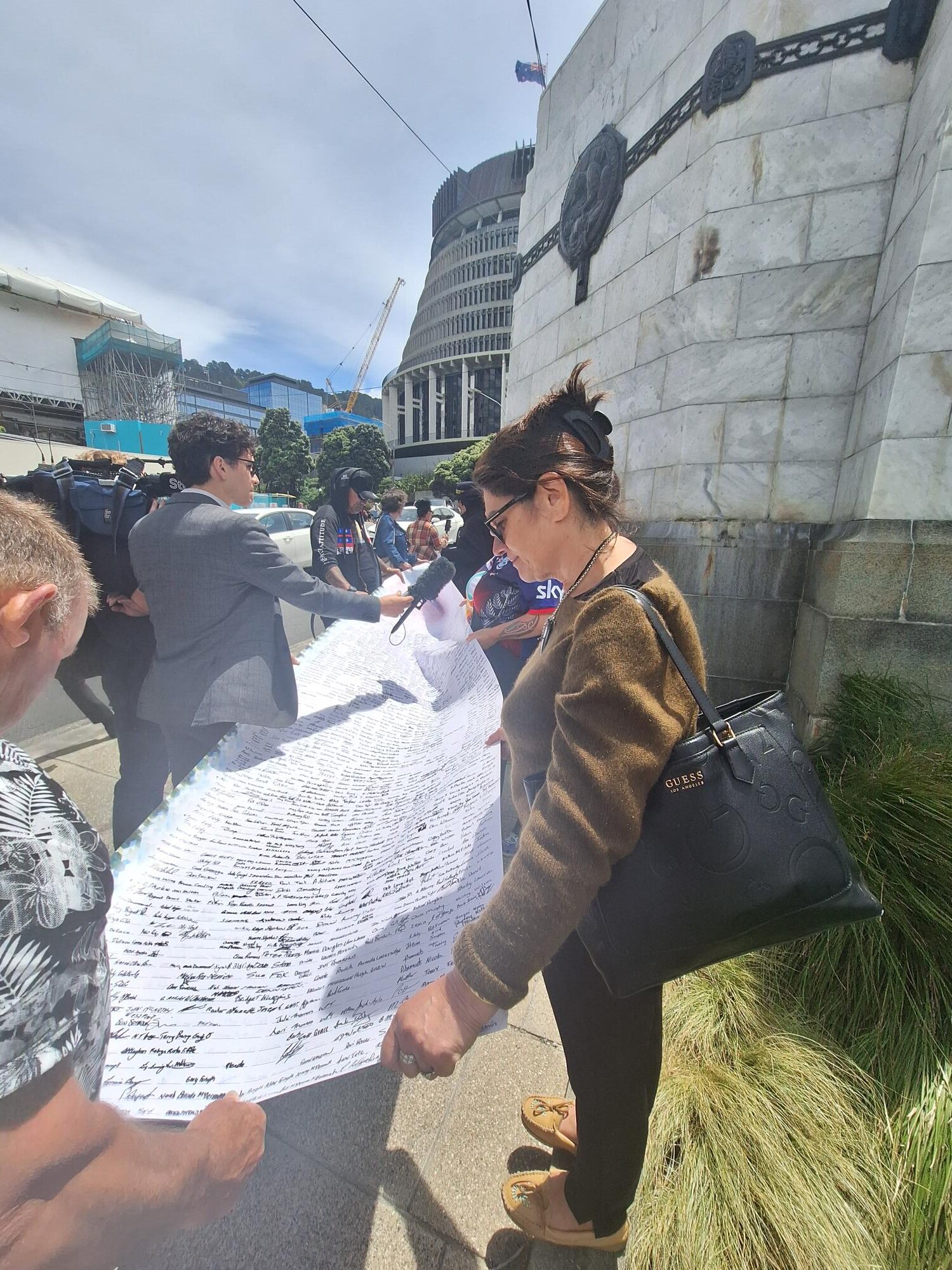
Midwifery should be joyful — and she’d loved all of it, she said. Even now she still saw the mothers she’d helped — “the children don’t know me, but I still recognise the family outline”.
“It’s really sad to see midwifery numbers depleted, because there’s not enough money to be able to do it.”
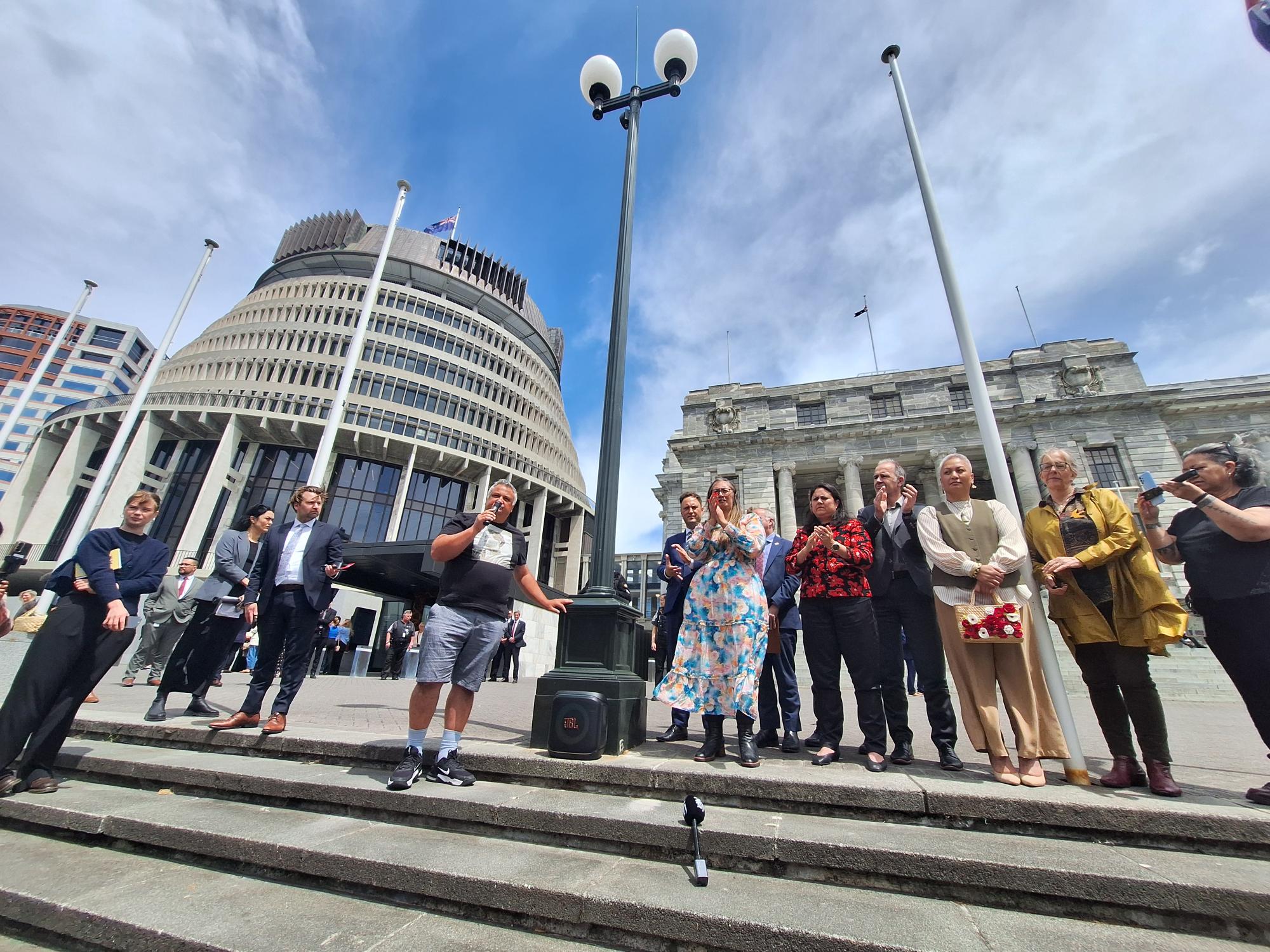
NZNO kaiwhakahaere Kerri Nuku was one of those who gave a kōrero at the presentation — saying she spoke as a mother, grandmother and a women “who has seen too many people die over the year because the system hasn’t responded”.
“Malcolm wears this on his heart — his wahine toa who passed away because services weren’t available.”
It was disgusting and wrong that politics got in the way of people’s rights to a just and fair health system, she said.
Health still a hot political issue
The latest Ipsos Issues Monitor survey released this week showed health care was still the number two issue — topped only by the cost of living.
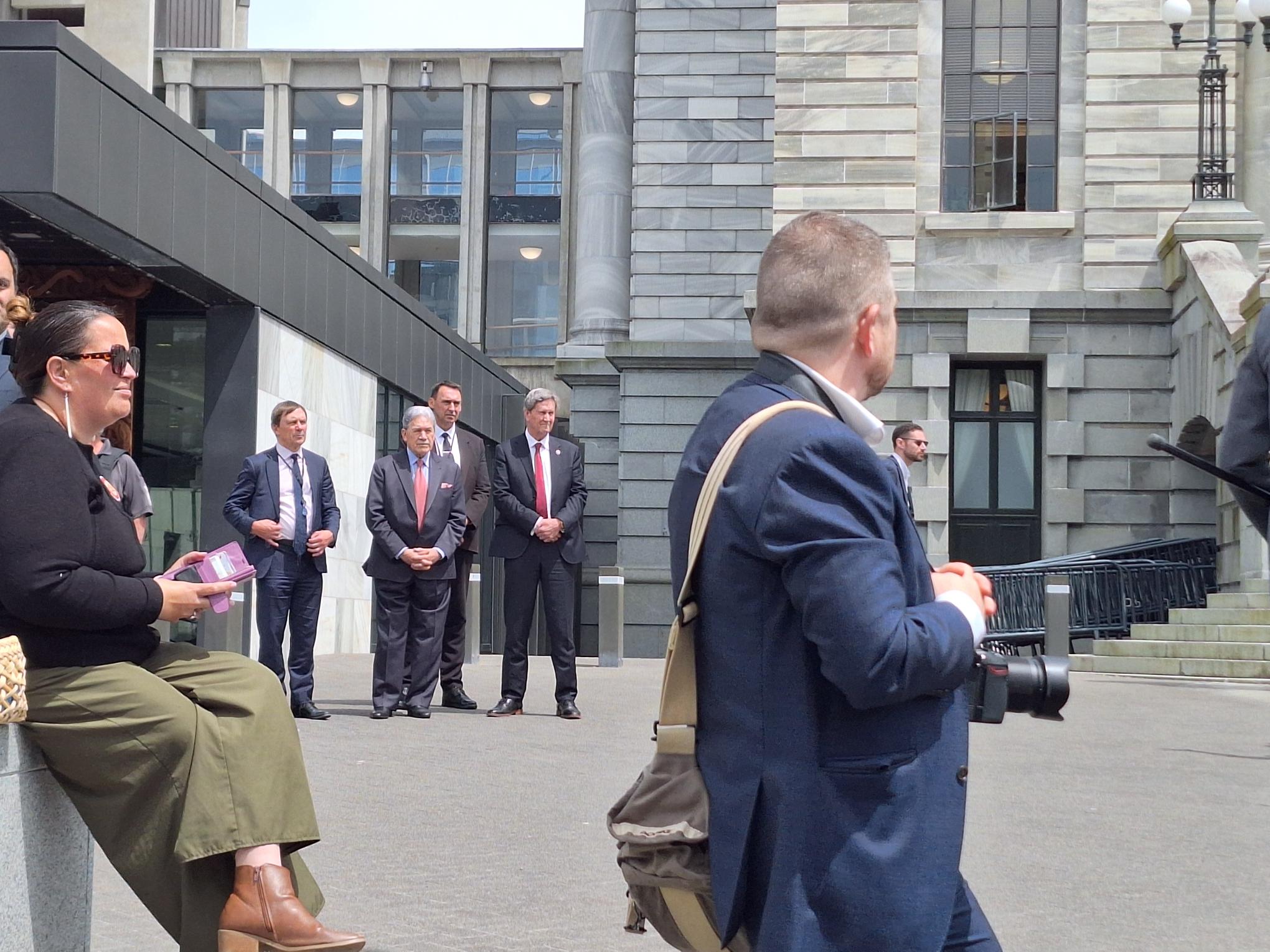
Nearly every party in Parliament was represented in some way at the ceremony, even if at a slight distance. The only parties absent were Te Pāti Māori and National.
NZ First’s Winston Peters stood apart from the others, near the Beehive entrance. ACT’s Todd Stephenson spoke but was loudly heckled by audience members.
Labour health spokesperson Ayesha Verrall said in her travels around the country she heard stories of a system under pressure.
It was common to hear about people being bumped off face-to-face services and shifted to telehealth instead, she said.
“We’re seeing some of the biggest strikes by health workers in my lifetime; we’re seeing the roll-back of services for Māori and the specific provisions for Māori in our health system.”
Greens MP Hūhana Lyndon, who officially received the declaration, said nobody could close their eyes to the size of the petition.
“Let no-one be left behind, whether you’re from rural Taitokerau (the Far North), Buller in the Deep South or whether you’re urban South Auckland.”
What does the declaration say?
- Aotearoa New Zealand’s health system is in a state of crisis.
- The Government must act urgently to address that crisis.
- Rural, Māori, and low-income populations are disproportionately impacted by the crisis.
- The Government must act urgently to meet its obligations under Te Tiriti o Waitangi and protect Māori health, in consultation with iwi and hapū.
- The Government must allocate the resources needed to train, recruit and retain more nurses, midwives, doctors, specialists, allied health professionals, health assistants and other health workers. to train, recruit and retain more nurses, doctors and specialists.