



Nurse Hayden Wallace has found a quiet (ish) spot by the picket line outside Kenepuru hospital, near the sausage sizzle, to start the pump that will deliver milk through a nasogastric tube to baby Willow, one of his twins, sitting snugly inside a carry chair.

Work might have halted amongst the NZNO nurses at the hospital, but you’ve got to carry on with the feeding, he says, matter-of-factly.
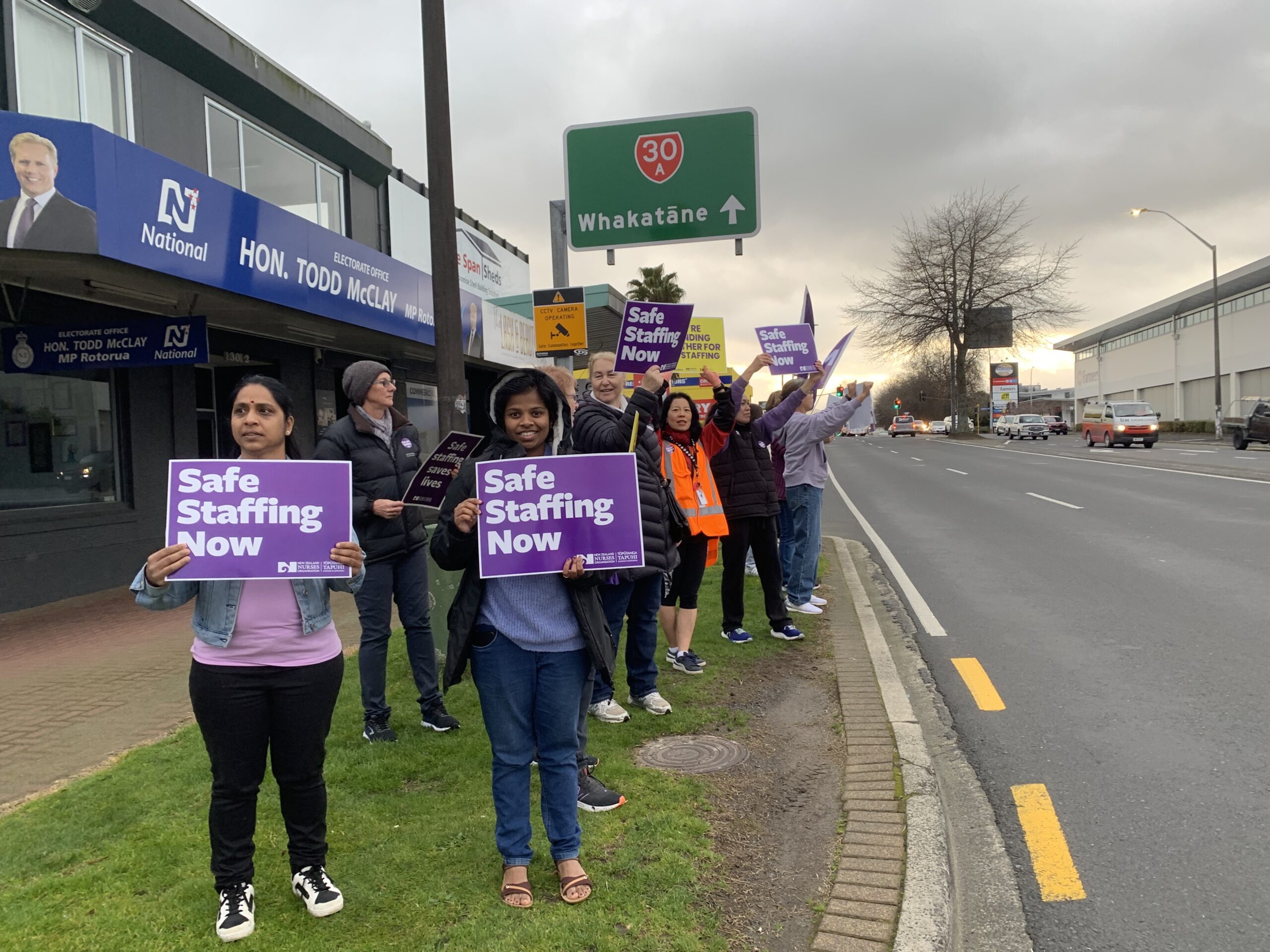
Wallace was one of 36,000 Te Whatu Ora members nationwide who joined the first of two strikes this week — from 7am to 11pm on September 2 and September 4.

He is the dad of year-old twins — Max and Willow — prem babies who were born at 28 weeks. But, he says, they’re doing ok now.
They were joining him on the rowdy picket line of Te Whatu Ora strikers outside the hospital — drawing toots from cars, chanting and laughing.
The twins are part of a set of six kids, he said. “We bought four, but got six.”

At a glance
- The week’s strikes come after Te Whatu Ora was forced by the Ombudsman to disclose damning Care Capacity Demand Management System (CCDM) data on staffing levels.
- It showed 37 per cent of shifts last year were short-staffed — some wards more than 90 per cent of the time.
- Te Whatu Ora was slammed for gaslighting nurses who previously raised the alarm over chronic understaffing and compromised patient safety.

Wallace said he was standing up for his patients. “To get them [Te Whatu Ora] to acknowledge the data that we’ve been collecting for the last 10, 15 years, rather than pretending it doesn’t exist.”
To him, nursing meant the satisfaction of seeing the hospital’s patients walk back out its doors — be able to regain their life again.
‘Helping my dying mum set me on this path’
Gwen Taitua, registered nurse for four years, is on the picket line because she’s worried about patients getting the support, care and services they need. “We need more nurses!”

What nursing itself meant to her was something more personal.
“Looking after my mum at her end stage of life just drove me to where I am now.”
Even despite that experience she had known from a young age it was something she wanted to do. “Oh yes, from a very young age: knowing that others need care.”
There’s signs of spring everywhere on the picket line. A lamb is at this event, brought along ahead of a visit to the vet later that day. It is wearing a vest and a diaper: as one person says nearby, the lamb is sick.

Nearby is Mao Ulu who works in Kenepuru’s ward 4, rehabilitating elderly patients who have broken bones.
She has brought 11-month daughter Alora Ulu — one of her three children, all under five. “I’ve got a four year old, a one year old, and 11 months. It’s been a bit of a juggle but we make it work when we can.”
Nursing means a lot to her, she said, coming from a family that had “no healthcare in the background” of their lives. “And really I just enjoy seeing our patients be able to leave the hospital — provide as much care for them as possible.”
Support came ahead of the strike from extraordinary nursing tutor Grace Benson — 87 and still teaching at Manukau Institute of Technology (MIT).

Over her 43 years teaching at MIT, thousands of nursing students had passed through her classes.
For patients to experience the real meaning of nursing — having someone who walks with them, who cares about them — well, that needed skill and time, Benson said.
“We need better staffing levels . . . and new nurses need to be precepted by registered nurses who have time to teach them — and that doesn’t always come out in the media.”
Not fit for purpose?
After apologising to NZNO for not releasing the data, Te Whatu Ora suggested CCDM wasn’t fit for purpose and floated a new “safe care approach for nursing”.
“There’s no one, internationally agreed, way of determining how many nurses, doctors, mental health professionals or allied health staff should be rostered to work each day,” said spokesman Dr Richard Sullivan in a written statement.
However, nursing graduates, and 2024 graduates, faced a job shortage in hospitals — only 45 per cent matched with work in the mid-year Advanced Choice of Employment (ACE) programme.

Media reports have revealed that in a bid to employ more graduates, Te Whatu Ora had squeezed more .6 FTE positions into the system.
In July, 36,000 nurses, health-care assistants and midwives went on strike for 24 hours.