


At a glance: Pay equity changes
- All 33 existing pay equity claims are cancelled and must be raised again under new rules. Of these, 12 were from NZNO or NZNO with other unions.
- New restrictions on what male-dominated workforces can be used to compare salaries (comparators) of the female-dominated occupations. First, they should be employed by the same employer. If there is none, it should be another employer with workers doing the same or similar work. If there is none, they should be employed in the same industry, sector or occupation.
- The employer can now determine comparators.
- Pay equity claims settled prior to May 15, 2025, (when the amendments came into law) cannot be used as benchmarks.
- New claims must meet a new “merit” standard before being raised rather than “arguability”, as previously.
- A workforce must now be 70 per cent female to be eligible to raise a claim, instead of 60 per cent. (This is not a barrier to us in nursing, which is nearly 90 per cent female.)
- Employers can opt out of a multi-employer claim without a reason.
- Parties must assess market factors that potentially affect pay.
- A new 10-year rule means settled claims such as Te Whatu Ora nurses and three NZNO/PSA/E tū care and support worker claims cannot be reviewed, only re-raised after 10 years. That means it will be 2027 before 65,000 care & support workers can re-raise their claim and and 2033 for Te Whatu Ora nurses and kaiāwhina.
For more details, see NZNO’s pay equity factsheet. Updates on each claim can be found here.
NZNO has always been a trailblazer when it comes to fair pay for female-dominated occupations such as nursing, midwifery and support workers.
We were a key backer of the Employment Relations Act in 2000, which replaced the 1991 Employment Contracts Act with less adversarial laws supporting collective bargaining for workers.

And we were one of the first unions to win a national multi-employer collective agreement (MECA) in 2004, with then-district health boards. That resulted in the biggest pay jolt members covered by that MECA had seen for many years.1
We fought hard with other unions to win a historic $2 billion care and support workers’ pay equity settlement in 2017, locking in pay increases for the next five years, to 2022.

And when the Labour-led Government amended equal pay laws in 2020 allowing female-led workforces to raise pay equity claims outside court, we went into bat for our 30,000-plus members working at Te Whatu Ora.
That led to another historic $4 billion pay equity settlement in 2023 and paved the way for more claims across nursing sectors.

We’ll stand our ground
So we certainly won’t be backing down now, in the face of this Government’s sudden and sweeping erasure in May of all 33 current pay equity claims, worth an estimated $12.8 billion, alongside its introduction of tough new thresholds.
Instead, we’re going to push on and re-raise our claims.
With NZNO’s 12 active pay equity claims — alone, or with other unions — on behalf of 13,000 members, plus a review of 36,000 Te Whatu Ora members’ 2023 settlement, now dumped, the income of more than 50,000 hard-working nurses and kaiāwhina across hospices, hospitals, aged care, primary health and in our communities depends on it.
And while there is a widespread view that the new barriers are prohibitively high, we are determined to test this. Until then, we won’t know for sure how strong they are.
What now?
First up will be those claims which were furthest along — Whānau Āwhina Plunket and hospices.
For Plunket, after nearly two years of work, a settlement was just weeks away.
Using the 2023 Te Whatu Ora settlement as a comparison, we were getting close to confirming the pay gap between a hospital and Plunket RN — estimated to be at least 18 per cent — before the shock May move tore it from our nurses’ hands.
So, losing that as our benchmark settlement was truly gutting — we could see the finish line.
And for hospices, even with 27 employers involved, we were close to settlement — work which is all now down the drain as we start again.
From there will be primary practice and urgent care nurses. This was a complex claim due to having around 800 employers involved and had been particularly challenging to set up — hence it was especially devastating when all that work was extinguished.
Aged-care nurses are also a priority, with the sector enduring a huge staffing crisis, before we start re-raising all remaining claims as quickly as possible for our members in community care, Sexual Wellbeing Aotearoa and laboratories.
The three claims* raised jointly in 2022 by NZNO with E tū and the Public Service Association (PSA) for care and support workers — a 65,000-strong workforce across aged care, disability, home and mental health support — after the 2017 deal expired must now be shelved until 2027.
There’s not many things you go into, with the rules clearly established and agreed at the outset, that allows another party to come in and completely change the rules.
This is because of a new rule barring claims from being reviewed or raised within 10 years of a previous settlement — another change we are calling to be reversed.
That also impacts on our Te Whatu Ora members, whose 2023 settlement was due for review, but must now wait till 2033 to ensure they are not falling behind similar male-dominated occupations.
Te Whatu Ora nurses’ settlement out of bounds
Another nonsensical blow is that we cannot now use pay equity claims settled prior to the May 15 amendments as comparators.
This rules out the 2023 Te Whatu Ora settlement — despite us demonstrating their nurses’ work is “the same or significantly similar” work to members in other sectors, as the Equal Pay Act requires.
As far as we’re concerned, the work of a nurse is the same, no matter where they work. We proved it through the Plunket and hospice nurse claims work assessment process — which provided evidence to show it was easily comparable with that of Te Whatu Ora nurses.
It’s an obvious comparator and would have resolved pay equity and pay parity — paying all nurses, everywhere, the same — in one hit.
So, losing that as our benchmark settlement was truly gutting. We could see the finish line. We weren’t over it but we could see it — and now there’s no longer a finish line!
There’s not many things you go into, with the rules clearly established and agreed at the outset, that allows another party to come in and completely change the rules, with no transition, no consultation — nothing.
Limits on male-dominated comparisons
Prior to May, we were able to work with employers to identify comparable male-dominated workforces doing “the same or significantly similar” work against which to establish pay equity rates. As long as they were 50 per cent male, willing to participate in the work assessment process and share their pay rates, it was all good! We ended up using police — sergeants, senior sergeants and detectives — along with mechanical engineers and corrections, customs and fisheries officers as our comparisons.
We must now find other male workforces within the same employer doing “the same or significantly similar” work. If there isn’t one, we need to find an employer with workers who do the same or significantly similar work. If there isn’t one, we have to find a workforce that is employed in “the same industry, sector or occupation” doing the same or significantly similar work.
But in a female-dominated field like health, it’s very hard to find a comparable male workforce — there is not even a common view on the definition of a “sector”.
It is not clear what the options might be unless we are able to go outside the health sector.
On top of all that, employers can now also veto comparators and, if none can be found, can opt out of the claim, without having to give a reason.
 A cross-union petition demanding the Government undo its mass cancellation of pay equity claims and deliver pay equity to people in female-dominated professions has drawn nearly 90,000 signatures. It is being handed over to Parliament on Wednesday July 23 at 1pm. NZNO members and pay equity supporters and whānau are invited to attend. Sign the petition here.
Time to ‘get political’
Even before all these changes, raising pay equity claims was time-consuming and complex. While there were hurdles, they were overt and transparent — we knew what we needed to do; there were milestones we needed to meet.
But when National-ACT-New Zealand First came into power in October 2023, the pay equity claims process began to languish. It was constantly shifting sand – they kept changing the rules.
In May 2024, the Government disbanded the Public Service Commission’s pay equity taskforce — set up by Labour three years earlier to support the pay equity claims and bargaining. So that was another hit to our claims’ progress.

The Government also dismantled the funded sector framework which supported pay equity claims outside Te Whatu Ora such as those raised by primary practices. The framework ensured claimants were following the easier new pathways laid out in 2020 changes to the Equal Pay Act. It also allowed ministers to signal their commitment to funding claims.
While it’s about pay, it’s also about sex-based discrimination — which should not still be happening in 2025.
For us, these were clear signals that the Government no longer saw it as their role to be funding pay equity settlements.
We knew to get any momentum we had to make it political. While it’s about pay, it’s also about sex-based discrimination — which should not still be happening in 2025.
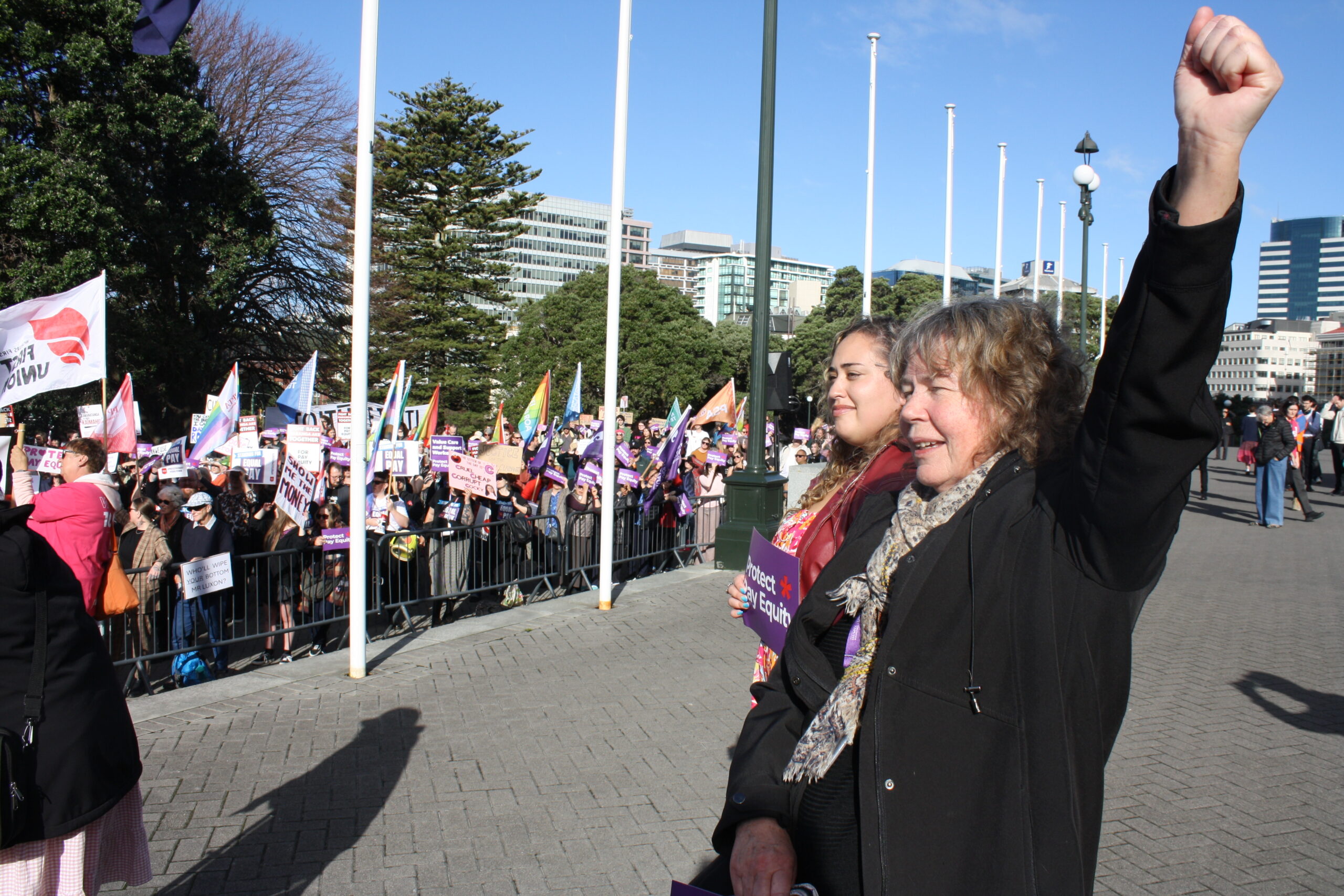
It’s a human rights issue — and we shouldn’t have to fight so hard for fair pay with even more barriers put up.
And while the amendments clearly create more barriers than we’ve ever had, NZNO will never give up on its mission to ensure members get the pay and recognition they deserve for their work.
*We started with a representative claim involved 15 employers in June last year first, then raised two more late last year when it became clear the Government was hell-bent on repealing all the 2020 fair pay mechanisms. That meant any settlement of the representative claim would not extend to the wider care and support workforce. The second claim was for 200 employers, with a third to capture any remaining employers.

— Glenda Alexander is NZNO’s pay equity advisor
- This article was amended on 24 July, 2025, to specify there were 12 NZNO pay equity claims and one review affected by the changes, representing more than 50,000 members.
Reference
- Paving the way for fair pay. (2005). Kai Tiaki Nursing New Zealand, 11(1), 14-17.