


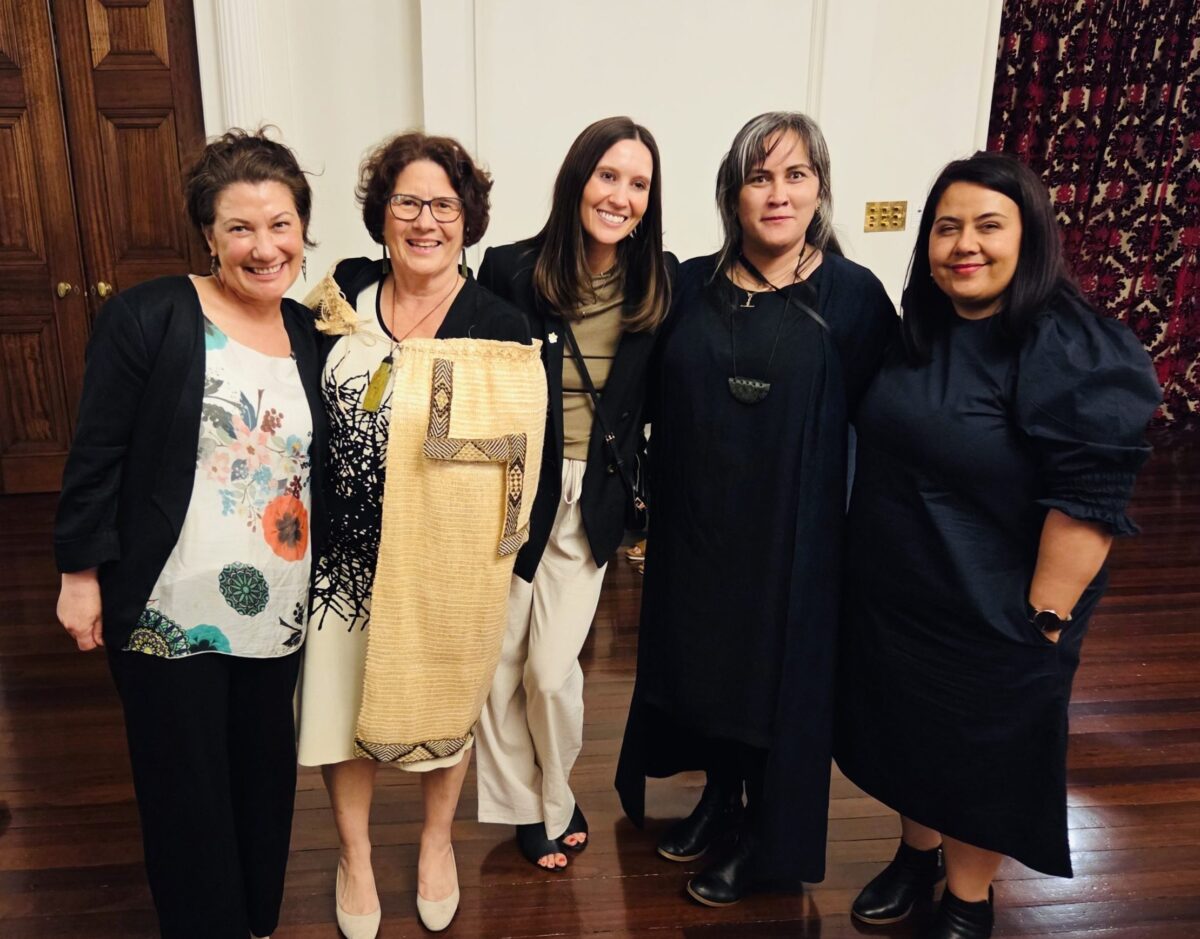
Riwai (Ngāti Porou, Te Aitanga a Māhaki, Te Uri o Hau, Ngāi Takoto, Inia), a NZNO’s women’s health college committee member, joined professor, Bev Lawton (Ngāti Porou) and other advocates at a 20-year celebration of leadership in women’s health and equity at Wellington’s Government House recently.
The event recognised Te Tātai Hauora o Hine – National Centre for Women’s Health Research Aotearoa, founded and directed by Lawton, (New Zealander of the Year 2025) for its work.
Riwai said it was an honour to have been invited and spend time with others working in the space.
“We’re all there for the same purpose and we all get it,” she told Kaitiaki.
“In other spaces you feel like you’re banging your head against a brick wall because you’re having to explain equity and remove equity from kōrero because the ministers have said ‘it’s for everyone’ . . . but if you get it right for Māori you get it right for everyone.”
‘I’d like to think we could eliminate cervical cancer. We just need to have the backbone supported — what’s happening on the ground.’
Eliminating cervical cancer remained the goal — despite the stripping away of equity-based health care by the current Government, she said.
“I’d like to think we could eliminate cervical cancer. We just need to have the backbone supported — what’s happening on the ground.”
Māori have a 20 per cent higher cancer rate and are twice as likely to die than non-Māori, according to Māori cancer specialist and research network Hei Āhuru Mōwai. Māori women are more than twice as likely to be diagnosed with cervical cancer and 2.5 times as likely to die from it as non-Māori, according to the National Centre for Women’s Health Research Aotearoa.
“If we look at whānau and the lived experiences, we look at the access to health systems – they haven’t changed. We haven’t changed the hours, cost factors, community broadening of service availability. There’s still those obstacles. When we look at equity, it’s got to come from a whānau voice,” Riwai said.
“We’re never going to lose focus and we’re going to continue to be unapologetic and to call things out and to raise that voice and ensure whānau voice is at the centre of everything.”
‘Support the kaupapa’ — NZNO
Women’s health college chair Jill Lamb said Riwai’s mahi with whānau-driven charity Smear Your Mea and cervical screening reflected the kaupapa of advancing equitable care for wāhine and whānau across Aotearoa.
The 20-year anniversary event also highlighted the wider work championed by Lawton in cervical screening, HPV self-testing, maternal and perinatal health and women’s wellbeing, Lamb said.
The college was committed to supporting this vital mahi and the shared goal of eliminating cervical cancer in Aotearoa.
Riwai has previously spoken to Kaitiaki about the influence of Smear Your Mea founder Talei Morrison, who died in 2018 at 42 from cervical cancer.
A charge nurse manager at Waikato Hospital’s Māori health directorate, Riwai leads the Hauora iHub, a culturally-safe service providing free cervical screening, care coordination, navigation and advocacy. She also works with the hospital’s planned care services to address barriers to outpatient clinic attendance, does mobile community cervical-screening and is a trustee of the Smear Your Mea charitable trust — all in support of cervical cancer elimination alongside the roopu led by Lawton.
Riwai is working towards her PhD at the University of Auckland, as a recipient of a Cancer Society/Hei Āhuru Mōwai Māori cancer research scholarship. Her doctoral research focuses on strengthening national cancer screening programmes for Māori through culturally-safe, accessible and whānau-centred services.
A global cervical cancer elimination initiative was launched by the World Health Organization in 2018.