



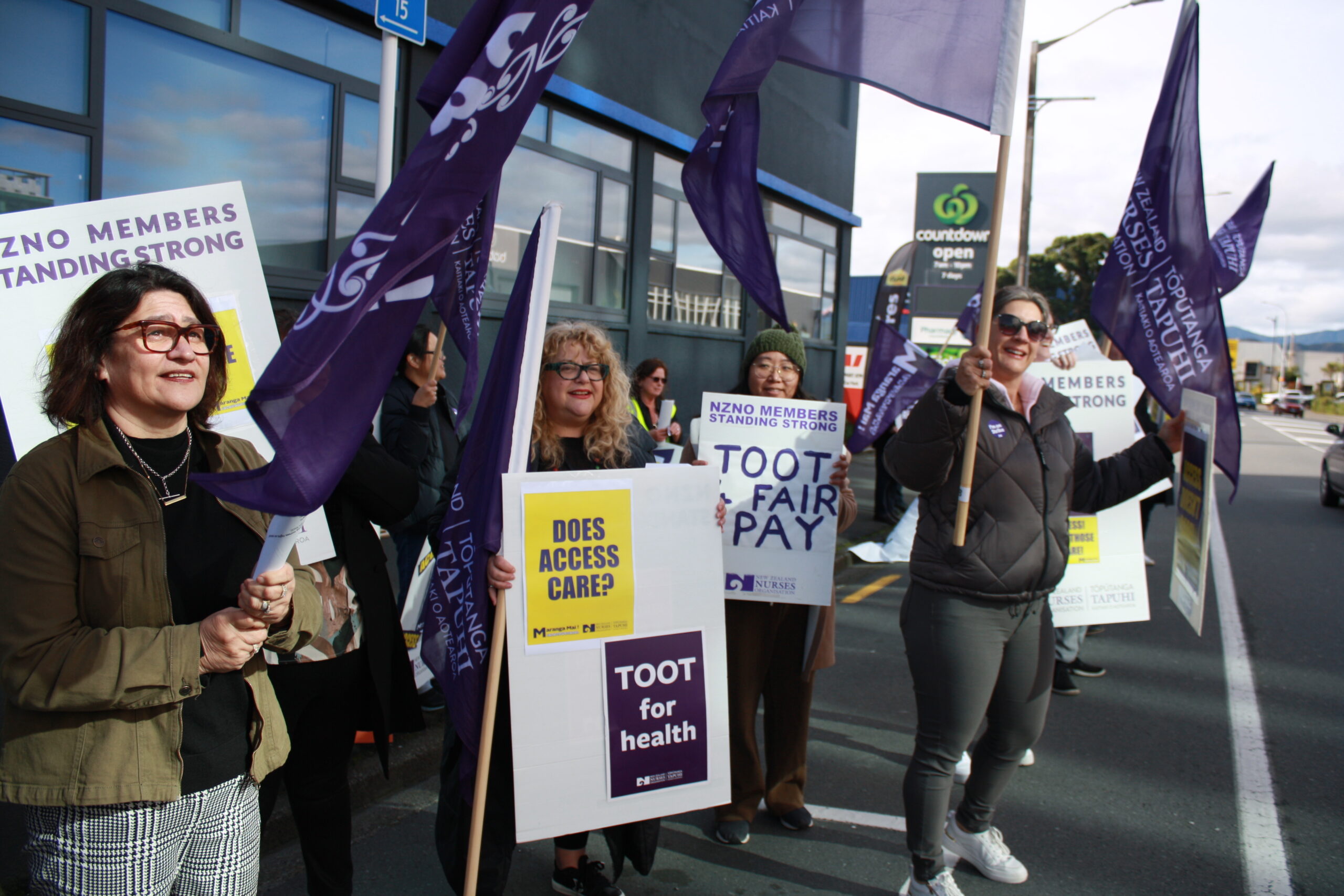
After six months of bargaining, Access Community Health nurses are celebrating a six per cent (three plus three) pay rise, professional development, long-service leave and yearly salary scale progression for the first time.
But delegates on the bargaining team say they felt disrespected throughout, dealing with eye rolls and concerns being described as “boring”.
“I could not understand why I had to go in there, fight tooth and nail for what is standard across the sector,” NZNO delegate Rachael Webb told Kaitiaki. “Having eye rolls and being told I’m ‘boring’ — fighting for things that should just be given. . . It makes me angry.”
NZNO collective bargaining for about 140 community and district nurses who work at Access kicked off last October with a three per cent (1.5 per cent now and 1.5 per cent in a year) offer — and nothing else.
‘It’s not just us they hurt, it’s the humans we look after. We’re looking after the community.’

But the workers stood firm — despite being told by Access it was “very comfortable” being one of the sector’s lowest-paying employer and with its high staff turnover, delegate Hollie Ashmore said.
“Maybe what changed is that Rachael and I were very hardcore with them, as much as they were with us.”

Webb said they had to go through two mediations before finally taking an acceptable offer back to members.
“We got there because we just kept pushing, coming up with examples about why they needed to support us,” Webb said. “But we shouldn’t have had to go back so many times and two mediations to get that message across because it’s just standard practice for nurses.”
Members this month accepted the offer for a two-year agreement, with:
- A professional development and recognition programme (PDRP) for the first time, with an allowance and start date in 12 months.
- Long-service leave for the first time (after seven years).
- Automatic yearly progression through the salary scale for enrolled and registered nurses.
- A three per cent increase from March 29 plus another three per cent increase in March 2027.
The previous collective only allowed workers to progress a single step during the agreement, meaning some had worked for years with little-to-no pay progression.
And while happy with the wins — especially the yearly step progression — they were relatively basic for nurses and the bargaining had been “horrible”, Ashmore said.
“It was blackening your soul, going in with this bargaining team. You just felt like you were just up against it,” she said.
‘We deserve respect’
Ashmore said nurses devoted their lives to helping people and did not deserve such disrespect.
“It’s not just us they hurt, it’s the humans we look after. We’re looking after the community.”
Disrespect ‘disappointing’ says Access
Access chief executive Androulla Kotrotsos told Kaitiaki she was pleased Access and its nursing workforce were able to agree on “a number of important matters” like pay increases, PDRP support, automatic step progression and the introduction of long service leave.
But it was “disappointing to hear that some participants may have felt disrespected, as that does not reflect our intentions or the values we seek to uphold”.
‘In this context, it is not uncommon for there to be differing perspectives and expectations during negotiations.’
Bargaining took place in a “challenging environment” at time of tight health funding constraints and high living costs.

“In this context, it is not uncommon for there to be differing perspectives and expectations during negotiations.”
Kotrotsos said Access approached bargaining professionally, respectfully and in good faith.
Community nurses played a vital role in supporting individuals, whānau and communities across Aotearoa New Zealand, she said.
“We remain committed to providing fair and sustainable pay and conditions, supporting professional development, and maintaining a strong and stable workforce within the realities of a publicly funded health system.”
Access Community Health provides nursing and home help care at home for older people and people with disabilities or medical needs.
Its specialist mobile nursing service, Total Care, is also in bargaining. After a proposed 2.5 per cent pay offer over 13 months was rejected, it has now offered members a two-year agreement with three per cent now and 2.5 per cent in a year. Voting closes this Wednesday, April 22.
‘Maybe what changed is that Rachael and I were very hardcore with them, as much as they were with us.’
Access and Total Care were sold by Green Cross Health to Australian private equity firm, Anchorage capital Partners, in 2023 for $50 million. At the time of sale, the New Zealand stock exchange reported a pre-tax profit of $5.6 million from the two community health services.
Access community nurses went on strike in 2024 over their low pay rates compared to other nurses.