


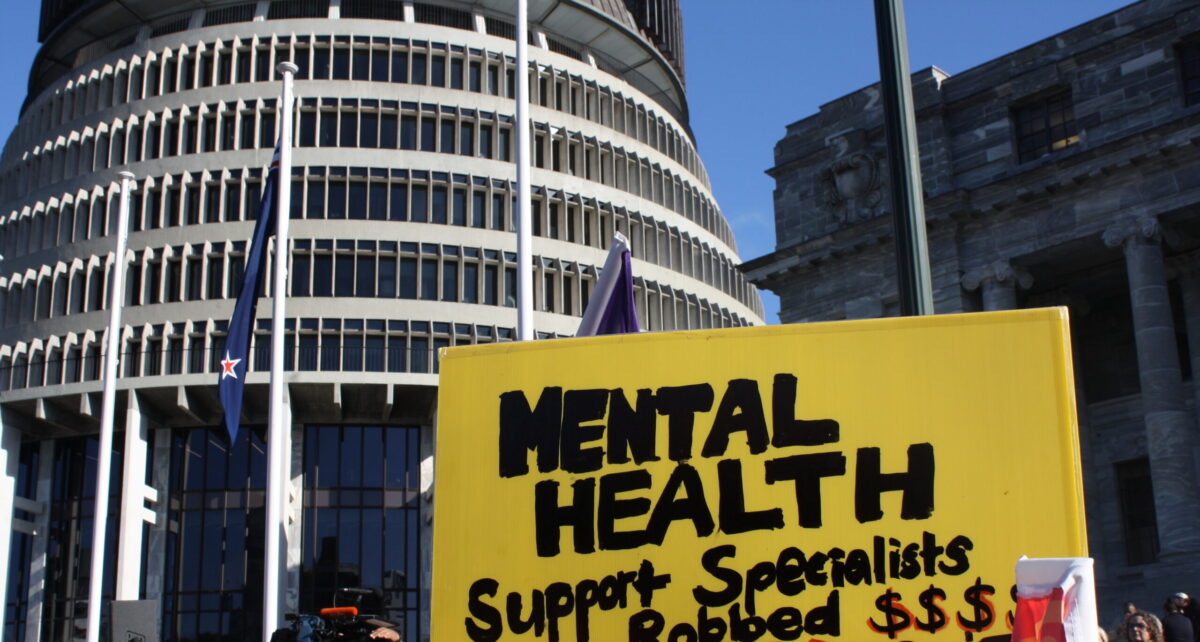
Doocey told off unions for spreading misinformation and not being “upfront” about a controversial new police policy, following the results of an NZNO member survey.
However it comes as questions are raised about how upfront Te Whatu Ora-Health New Zealand (HNZ) itself has been with the Minister on the policy’s impact.
In 2024, the Government announced plans for a phased police withdrawal from mental health call-outs. They said it would allow officers to focus on “core policing”.
The overwhelming majority of the 31 respondents in the new sample survey of mental health workers believed the changes had made them less safe.

Responses included one member’s experience in an emergency department (ED) where staff were punched, kicked and the respondent was strangled by a patient left by police.
Rather than respond to the story and topline survey results shared by Kaitiaki, Doocey attacked the messenger.
“I am continually disappointed by the misinformation that comes from the unions around the police change programme. They need to be upfront with their members and New Zealanders around what’s really happening around the police change programme.”
Doocey said he’d contacted HNZ and been told there were no serious incidents linked to the programme. “I would encourage any mental health worker to raise incidents with the appropriate manager so a review can take place.”

NZNO Mental Health Section chair Helen Garrick said she was not surprised by the survey results.
“Our feedback since this whole thing started from our members, and other nurses, was that this was a mistake.”
Garrick asked if Doocey even understood that the new survey came from members.
“Did he get that? We are upfront. We’re asking our members and we’re conveying what our members say.”
If Doocey had a dispute with what members were saying, then he needed to ask HNZ for the information provided to them from staff, said Garrick.
By the numbers
- Ninety four per cent of respondents said the police changes made them less safe at work.
- Nearly three-quarters, 71 per cent, said police were not responding when called to help with difficult patients.
- Ninety-four per cent had been subjected to unacceptable behaviour from patients — half of these subjected to physical violence.
- Thirty-nine per cent of respondents said they’d been physically assaulted since the police changes were phased in.
“We have been providing information,” Garrick said. “HNZ has information. We go to meetings with HNZ where specific incidents have been discussed. And yet he’s saying that they haven’t found any link to the police change programme?”
Members had been consistently raising incidents with management, she said.
“We do. We have. And we continue to do so.”
‘No longer our responsibility.’
One survey respondent shared how mental-health clinicians and ED nurses were left with a violent patient by police.
Staff were alerted to the incoming patient (detained under section 109 of the Mental Health Act) by a phone call from an officer while he was getting punched in the back of the head by the patient.
Upon arrival at the ED, the patient — in methamphetamine-induced psychosis — punched a triage nurse. When two mental health clinicians arrived, police insisted on leaving immediately.
“I pointed out to police the patient’s clearly aggressive behaviour and they advised it was no longer their responsibility to stay.”
After police left, violence towards the ED nurses and mental health clinicians included being kicked and punched, and the survey respondent being choked.
After about 10 minutes ED administrative staff called 111 — eventually it required three police officers, two mental health clinicians, and two security guards to administer an intramuscular injection.
Once the patient was sedated the police left again. “Police were very dismissive to the point of rudeness on their return regarding us and ED not being able to manage the situation.”

Doocey said unions should not be politicising a programme he claimed was creating clearer communication lines and ensuring people received a mental health response.
Patient and staff safety was the top priority, he said — shown by an approach where each phase was activated “when and if it is safe to do so”.
Garrick said Doocey’s response was “actually quite infuriating”. “It’s because they’re not listening . . . if Matt Doocey isn’t getting those things then he needs to go back to upper management at HNZ and say ‘I need more information’.”
What police say
Police acting director of prevention Kyle Sherson did not directly address queries about the ED incident raised in the survey.
Phase two of the programme introduced a 60-minute handover time in EDs for patients detained under the mental health law, he said. Police were required to carry out safety assessments before leaving — they were expected to remain if it wasn’t safe to do so.
Sherson said police were working with HNZ to make sure the programme was implemented in a way “that ensures that appropriate care is provided to those in mental distress”.