


The Sunday Star Times, reporting on a Council procurement audit released under the Official Information Act (OIA), claimed its savings had plunged from $12m to $4m.
The depleted reserves could force a hike in annual nursing registration fees, currently $130, the story warned.

However a written response to Kaitiaki by the Nursing Council board says the story was incorrect — the Council had not spent $8m of its reserves. “We are unsure of the source of this assertion.”
‘I feel for the staff and people who are . . . impacted by this.’
Neither its own annual reports or the OIA audit information included the claimed disappearing millions — and Council sources contacted by Kaitiaki could not find them either. According to Council annual reports the reserve increased year-on-year since at least 2022 — hitting $13.8m in 2025.
The audit, covering the 2025-2026 financial year, was commissioned by the board in June and publicly released this month. It gave the Council its lowest rating for spending controls and pointed out problems such as potential invoice duplication, covering $1.29m of spending; incompatible computer systems, and an apparent blow-out in travel costs.
Several high-level Council sources who spoke to Kaitiaki strongly disagreed with audit claims that financial systems were deeply flawed — and were furious over the unsubstantiated $8m claim.
“I am so disappointed and angered,” said one. “I feel for the staff and people who are . . . impacted by this.”
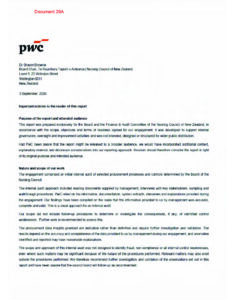
Meanwhile, Kaitiaki can reveal that auditor PricewaterhouseCoopers (PwC) was not made aware its report would be released publicly — and would have included a raft of additional material if it had known.

A letter to board chairperson Sharon Brownie, dated September 3, said the report was not “intended, designed or structured” for wider public distribution. It was meant for internal governance and oversight, it said.
“Had PwC been aware that the report might be released to a broader audience we would have incorporated additional context, explanatory material and disclosure considerations into our reporting approach.”
PwC said their scope did not include follow-up procedures “to determine or investigate the consequences, if any, of identified control weaknesses”.
“The procurement data insights provided are indicative rather then definitive and require further investigation and validation.”
Brownie took over as chairperson in April — part of a major reshuffle by Minister of Health Simeon Brown that saw several nurses and Māori ousted.
Brown has frequently complained about regulators’ “ideological agenda”, in June ousting Medical Council chair Rachelle Love and deputy Simon Watt over their cultural safety focus, along with most of the Nursing Council’s Māori directors.

In August chief executive Catherine Byrne and several senior executives quit the Council. Formerly a Taranaki director of nursing, Byrne was appointed Council chief executive in 2018.
Byrne declined to comment.
The board said the Council was undertaking further work to “address and mitigate identified risks” in the audit.

Registration fees had not increased for some time: the Council would reassess the fee with each annual budget and planning cycle, the board said. The Council had the resources to continue its work — “standard setting, maintenance of the register and fitness to practice”.
Audit response
- The PwC report cited travel expenses in 2024/25 of $101,000 spiking to $676,000 the following year. However, the former Council members told Kaitiaki that unfairly compared board-only travel to that of all Nursing Council members — board and staff.
- Daily expenses — “per diems” – for four board members were also singled out by PwC as averaging $350 a day, more than half of which was spent by one director. However, these were for the chair, deputy and co-chairs of the finance and expenditure committee who attended far more meetings than other directors, sources told Kaitiaki.
- All spending was approved and scrutinised by the Council’s finance and audit committee, subject to the Council’s budget, they said.