


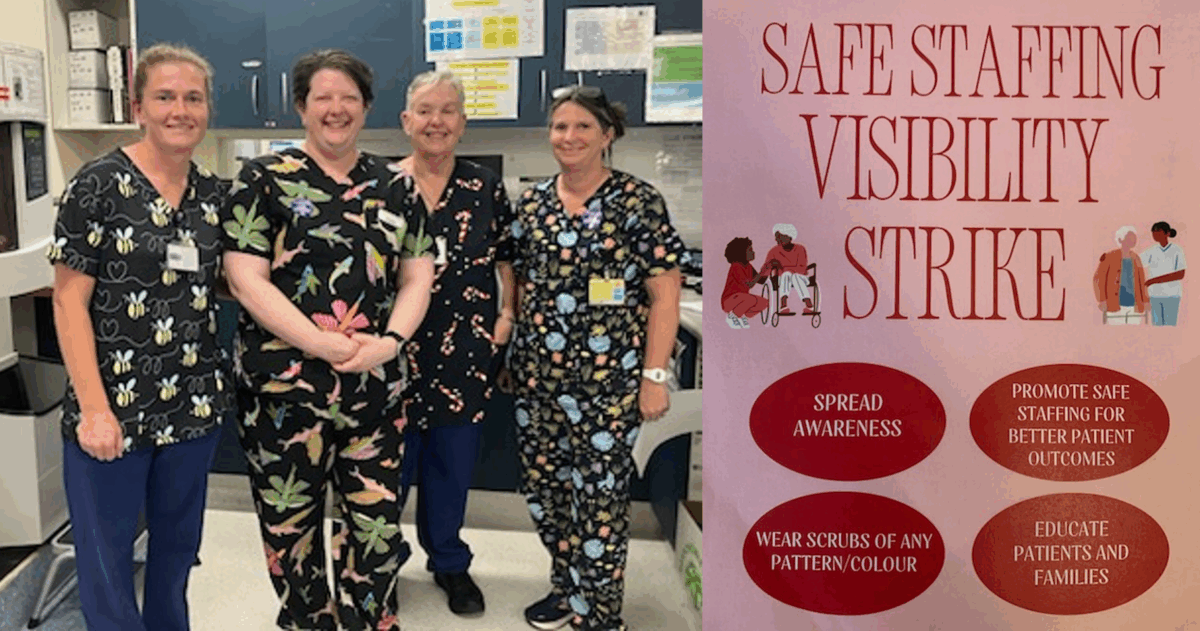
North Shore, Waikato and Nelson – set off visibility strike fever
Visibility strikes, also known as uniform strikes, have become an effective way to get out the safe staffing message since three groups of nurses and health workers, all members of NZNO, stopped wearing their standard work scrubs last year.


It began in August last year when North Shore district health nurses got fed up with constantly being short staffed.
“[We’re] short of six staff at least. We’re often working late, unpaid. It’s just really stressful as we have to triage on a daily basis about who we can and can’t see. It’s really shocking over winter,” NZNO delegate and district nurse Lesley Pook told Kaitiaki last year.

Oncology nurses at Waikato Hospital caught the visibility strike action fever in October to highlight how cancer, heart and trauma patients were being treated in the most understaffed wards in the country, with half of all shifts not meeting safe staffing levels.
That same month, Nelson Hospital ED nurses got the fever too.
The effectiveness of visibility strike action or uniform strikes is being experienced by more and more health workers at hospitals around the country. Many are changing from the standard blue uniform to different colours and designs to highlight serious understaffing issues.
“This type of action is effective. It pisses off the powers that be, but it allows us to keep alive our message about the need for better staffing, safer staffing,” Dietschin, who works as a health-care assistant at Christchurch Hospital, said.
“When patients, their family members and friends see us dress differently, from the standard staff uniforms, they usually ask ‘what’s happening here?’ and that gives us an ‘in’ to tell them about Te Whatu Ora and the Government refusing to fix the unsafe staffing crisis we’re experiencing.”

There are currently 86 public hospital sites and health facilities throughout New Zealand and more than 37,500 NZNO members working as nurses, midwives and health-care assistants in them.
Asked if visibility strikes at all those sites was realistic, Dietschin responded: “Yes, but they need to work with union organisers and be a bit creative – make their own safe staffing T-shirts if they can’t afford to buy them.
“The point is to dress in a new way that prompts patients and their family to ask a question.”
The visibility strike at Christchurch Hospital, which started October last year, had been so effective that NZNO members want to extend that strike action, Dietschin said.
Whangārei Hospital ED nurses join in
NZNO delegate and bargaining team member Rachel Thorn joined other nurses at Whangārei Hospital ED who began their two-month visibility strike last Thursday.
“We’ve been in bargaining with Health NZ for 18 months, much longer than we should be, and while they say they have a recruitment uplift underway to increase desperately needed nurses, in reality we aren’t seeing that on the floor.

“That’s why we are taking this latest strike action.”
When patients ask: “I tell them that this Government is purposely understaffing our hospital so it can save money – at the expense of their health and ours as nurses,” Thorn said.
Striking nurses are also wearing “striking for safe staffing” stickers and hanging safe staffing posters throughout the department, including, the public waiting area.
“Health NZ has told us that they will phase in 80 per cent of the nurses we need, but we’re thinking they won’t start that in any serious way until the next financial year (June). Our nurses are bleeding right now – they are exhausted and our patients are feeling it too in terms of waiting times.”
Thorn said that the ED was one to two nurses short per shift.
Thorn will continue to wear her frog and fish patterned scrubs rather than the standard navy-blue uniform through to the last day of the strike on February 28.
( NZNO-made safe staffing t-shirts can be purchased online )