


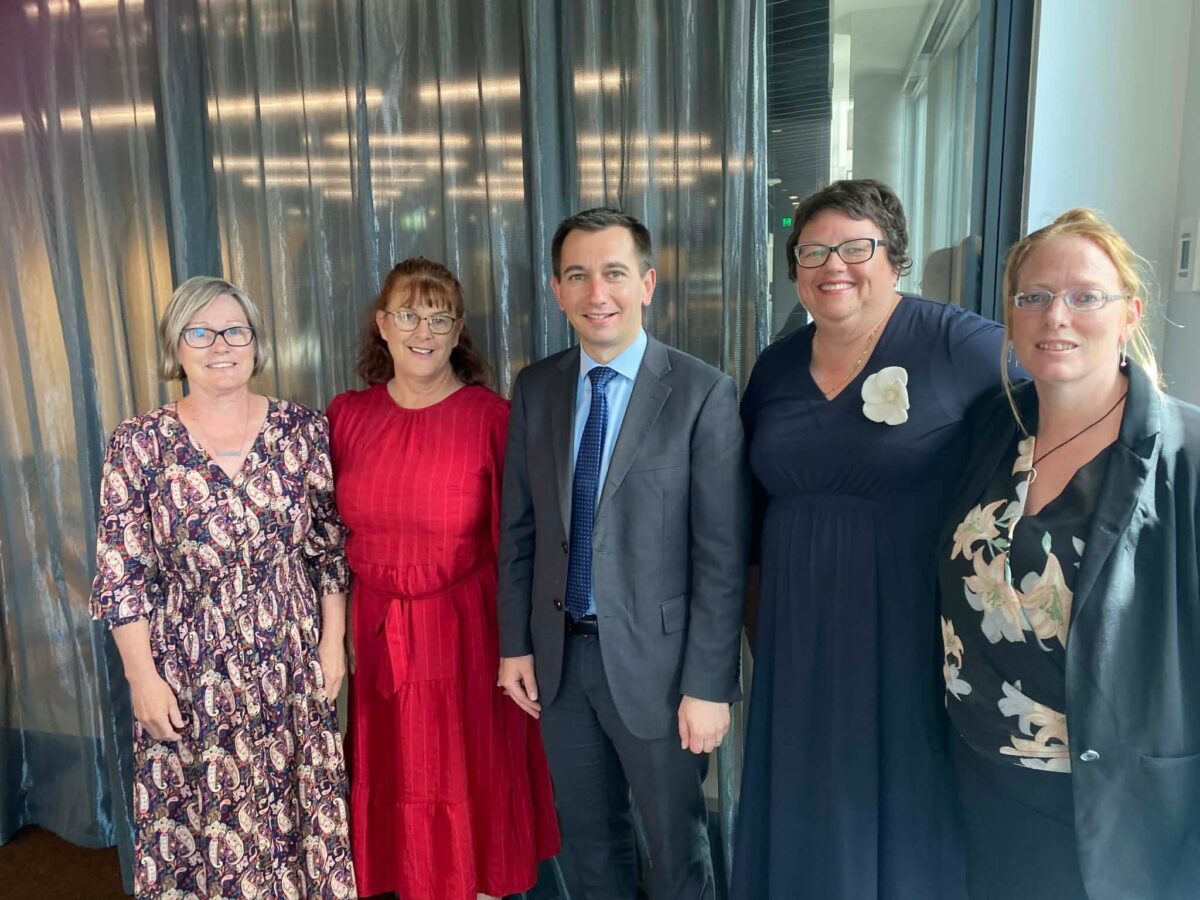
NZNO’s enrolled nurse section (ENS) tackled Minister of Health Simeon Brown this month to ask our workforce be better supported, utilised and recognised across the country.
At his invitation, we have since sent him a workforce plan to ensure our newly-expanded skills are fully realised.
Why do enrolled nurses (ENs) matter? We are regulated nurses under the Health Practitioners Competence Assurance Act and deliver safe, high-quality care across acute, community, aged care, mental health and private surgical settings. We undertake health assessments, wound care, catheter management, ECGs, immunisations and leadership roles.
Enrolled nursing is at a pivotal stage with a new scope of practice that frees us from the direction and delegation of our RN colleagues.
While the changes enable ENs to deliver safe, patient-centred care and work collaboratively across all health settings, uptake remains slow.
This allows us to work in emergency departments (EDs), general practice, rural primary health, after-hours medical care, private hospitals and prisons — areas that have primarily been the domain of RNs.
While the changes enable ENs to deliver safe, patient-centred care and work collaboratively across all health settings, uptake remains slow.
Myself and other ENS committee members met Brown on December 4, to raise concerns over three critical priorities:
1. Implementing our new scope of practice:
In our kōrero with the Minister, we spoke of the benefits, such as expanded clinical and cultural competence, better quality and safety and workforce flexibility. Yet, Te Whatu Ora-Health New Zealand policies remain outdated, limiting the utilisation of ENs. Workforce supply does not meet demand, and ENs are often replaced by less-qualified staff.
Despite national direction from the Nursing Council and Ministry of Health, inconsistency remains across districts and services in understanding our new scope — and where we can work.
In many settings, ENs continue to be restricted from practising to the top of their scope due to local policies, historical workforce models or limited employer understanding of our new competencies. This impacts patient care and workforce flexibility.
We urged the Minister to ensure full implementation of our scope and support ENs through continuing training, professional development and clear nursing team collaboration protocols.
2. A targeted EN workforce plan
We also expressed our concerns that there is currently no dedicated workforce plan for ENs. This has resulted in limited EN graduate employment, restricted opportunities within Te Whatu Ora-Health New Zealand and funding contracts that fail to recognise ENs.
Currently, there are inequities how graduates are supported into the workforce. Te Whatu Ora funds primary and aged care employment pathways for graduate RNs but offers no equivalent support for ENs — despite clear workforce data showing growing demand.
Just a handful — 15 per cent — of our latest EN graduates have so far been matched to supported-entry roles at Te Whatu Ora this year, compared to nearly half RN grads.
ENs have also recently been removed from Te Whatu Ora’s voluntary bonding scheme.
We called on the Minister to develop a workforce plan that:
- Defines EN roles in service contracts.
- Provides graduate employment pathways.
- Embeds ENs in national workforce modelling.
This will improve workforce sustainability, reduce costs, and enhance patient access to care.
3. Employing and fully utilising ENs
We had an open discussion with the Minister about the under-utilisation of ENs. Despite an 18-month training diploma and Nursing Council regulation, ENs remain under-employed and unable to work to full scope in many areas. This impacts patients’ access to care, workforce sustainability and health-care efficiency.
Te Whatu Ora’s 2024 workforce plan acknowledges an EN shortage of 170 full-time equivalents (FTE) now — projected to be 590 by 2033. Yet hiring remains stagnant and our scope only partially implemented.

We showed the Minister evidence that ENs represent only 3.5 per cent of the nursing workforce, with 2,433 holding practising certificates out of a total of 84,000, according to Nursing Council statistics at June 2025.
The Minister appeared interested in understanding EN practice and hearing about the issues facing the workforce. He expressed strong interest in understanding our value and seemed open to making the most of the EN workforce.
But it was a bit disappointing that after 60 years of enrolled nursing in New Zealand, we still had to outline to the Health Minister our role within the health system!
Recommendations
Following the meeting, we have written to the Minister with the following recommendations:
- A funded EN graduate employment pathway.
- National mandating that all districts use the updated EN scope.
- Integrating ENs into workforce redesign.
- Education for clinical leaders on EN capability and retention and progression pathways.
Under-using ENs — either by not employing them or failing to allow them to practise to the top of our new scope — is a barrier to achieving the Government’s own goals of better access and better health care.
ENs are ready to contribute more — the scope has changed, the need is clear, and the opportunity is now.