


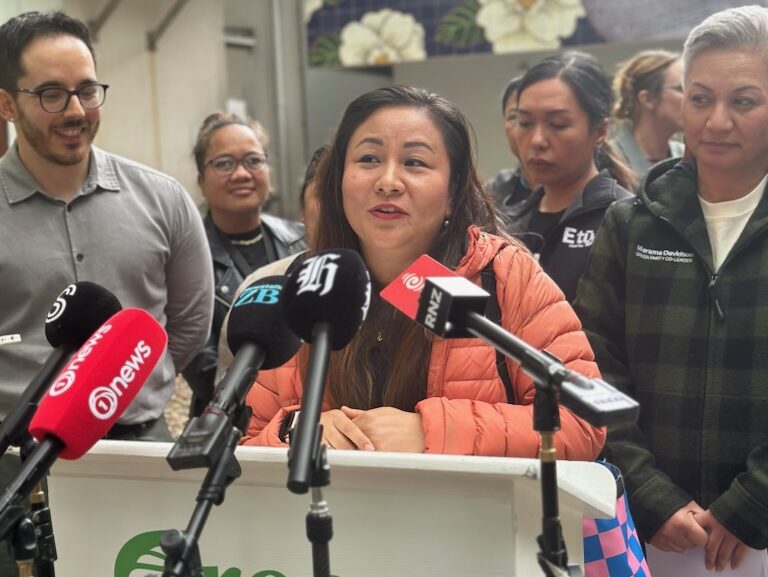
“This job is not easy, it’s really hard and undervalued — paid very low – and the majority of us are women. Historically, most care workers have been women and because we are women we are undervalued,” Lama, an NZNO delegate, told Kaitiaki.

Achieving pay equity had long been “a dream for us”, Lama said, so it was hugely disappointing when the National-led Coalition Government pulled the plug on 33 outstanding claims.
“Aged care-workers are among the lowest paid people in the health system and many of us are struggling with supporting our families, here and overseas. So that announcement last year was quite upsetting for us,” she said. “It’s like dangling a carrot and not delivering it.”
‘We need now a clear commitment to settle the claim and restore whatever confidence we have in the pay equity system.’
The Greens’ October 1 announcement – the first political party to provide a fully costed plan and timelines – was “encouraging”, said Lama, who was keen also to know what other parties proposed.
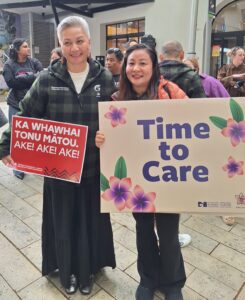
Greens co-leader Marama Davidson said the party would reinstate the pay equity framework and rapidly resolve the care and support workers’ claim — covering about 65,000 workers. The announcement outlined an “indicative” budget of about $4.5 billion over four years to get the job done.
Ahead of the Greens’ announcement Labour leader Chris Hipkins said a Labour-led Government would reinstate the pay equity framework in its first 100 days.
He would not say how much the reinstated pay equity might cost. Although Labour would also prioritise care and support workers, he said.
On May 6, 2025, the Government announced it was introducing and passing the law gutting pay equity the same day. At that point, 14 claims had been settled, and 33 were still underway. The changes saved the Government $12.8 billion for Budget 2025.
Work to gut pay equity, stretching back a year before the announcement, was shrouded in such secrecy that it had its own code name, Project Ten, and a no-attachments rule for emails.
A people’s select committee on pay equity was set up to give a public voice on the law change. In May, Pay Equity Coalition Aotearoa (PECA) lodged a formal complaint with the UN about the law change.
Meanwhile NZNO joined muti-union legal challenge in the High Court in Wellington — arguing that the Government’s gutting of pay equity breached the bill of rights.

For Lama, pay equity was about recognising the value of care and “making sure us workers and the people we care for get the support we deserve”.
“Pay equity would make a real difference for us, our families and our communities. We know the work has been assessed, the evidence gathered –- the solution is also there. We need now a clear commitment to settle the claim and restore whatever confidence we have in the pay equity system.”
The three claims raised jointly in 2022 by NZNO with E tū and the Public Service Association (PSA) for care and support workers — a 65,000-strong workforce across aged care, disability, home and mental health support — after the 2017 deal expired will be up for review in mid-2027, 10 years after being settled as required under the amended law.
Lama said she believed the Māori holistic model of health care, te whare tapa whā, should also apply to those giving care.“If we are well ourselves, we will deliver that care to vulnerable New Zealanders.”
There is no sector-wide collective agreement for care and support workers, who work across a range of areas and unions, from aged care to community care and disability support. Their hourly pay usually ranges from $27 to $31 per hour—barely increasing even after 10 years.