


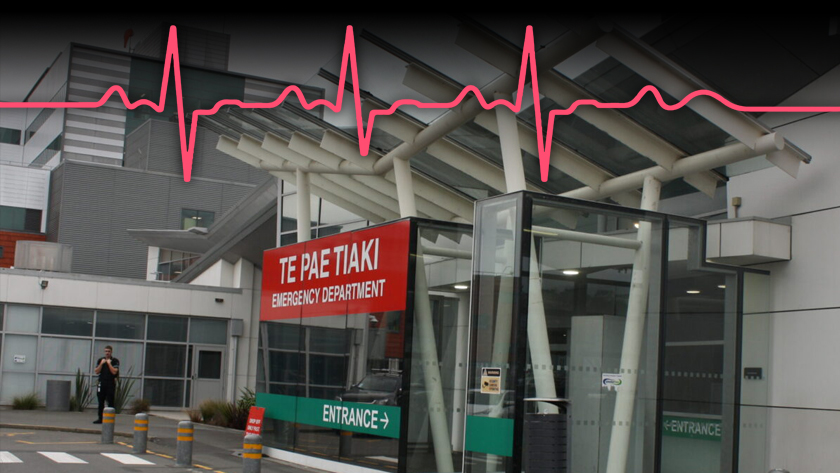
In a report released this week, health and disability commissioner Morag McDowell found Te Whatu Ora-Health NZ (HNZ) failed to provide the man with an appropriate standard of care in the 2023 incident.
Now HNZ has confirmed to Kaitiaki that three years later, barely over half of an ED staffing boost planned as a fix were on the floor.
Interim group director for operations in the district, Michelle Sutherland said of the 67 FTE extra positions, 37 were “in place”. Another 18 were being “onboarded” (prepared after hiring), and 12 were still being recruited.
Meanwhile NZNO college for emergency nurses NZ (CENNZ) co-chair Natasha Hemopo told Kaitiaki it was fortunate the situation hadn’t ended with a patient collapsed in the waiting room, like June’s Waikato ED incident. That incident, she said, had left some ED members there struggling to return.

The patient, a 55-year old man, arrived at the ED shortly after midnight in August, 2023 with burning central chest pain radiating over his back and left shoulder — the antacid Gaviscon hadn’t eased the pain. He was middle-aged, Māori and had a family history of heart attacks.

McDowell said he should have received an electrocardiogram (ECG) but instead waited hours before seeing a doctor.
A nurse gave the man a triage score of 3 when he should have been scored as a 2 — to be seen within 10 minutes. But even with the score of 3 he should have been seen by an ED doctor within 30 minutes, the report said.
When a doctor finally saw the man four-and-a-half hours after triage, an ECG was given, which showed he was having a heart attack. He was immediately referred to the cardiac team and given a stent to improve blood flow in the arteries in his heart.
“Health NZ said that, at the time of . . . presentation, the ED was at 200 per cent occupancy and had 20 patients who needed to be seen within four hours. In addition, there was a shortfall of 10 nurses for the shift,” McDowell said.
McDowell said the man’s symptoms and history should have raised immediate suspicions of a heart attack. He was given the wrong triage score and his wait to see a doctor was “inappropriate and well outside the expected timeframes even for the incorrect triage score”.
ED fixes
As well as the staffing boost the report outlined a raft of HNZ remedial action after the incident:
- Providing triage nurses with further education on cardiac symptoms.
- Planning to develop a hospital-wide escalation process for when the ED is at critical capacity.
- Introducing a waiting room nurse in 2024 to support clinical investigations following triage.
- Requiring that all ED nurses attend a triage course with CENNZ.
‘The ED was at 200 per cent occupancy and had 20 patients who needed to be seen within four hours. In addition, there was a shortfall of 10 nurses for the shift.’
Hemopo said members in the ED had told her that HNZ had not recruited the full additional FTE. “I know they say they’re going to, but . . . they’re still working at a deficit.”
It was lucky the man had finally received the care he needed, she said, in light of a man’s death in the Waikato ED waiting room toilets in June after a nine-hour wait.
“I don’t know what happened to that man at Waikato, but this person involved in the HDC case could very well have collapsed.”

Hemopo had spoken to Waikato ED members the previous week who were devastated by the incident there. “They’re having a hard time just to return back to work knowing that they’re going back into those environments.”
Management in Waikato hospital were quick to offer support after the incident — but that was “reactive”, she said.
“In the long-term, nationally, nurses in EDs are struggling, not only with the workload, the staff shortages, everyone’s having to backfill and do longer shifts and work in stressful environments. You’re giving care to people in corridors.”
Nurses were simply “fed up”, she said.
Improvements underway
Sutherland said HNZ had launched a range of improvements in response to issues in the report. These included “significant investment in staffing, clinical leadership and patient-flow initiatives” in the ED.
She said roles established since 2025 included nurse practitioners, clinical nurse specialists, a charge nurse manager and senior medical officers.

“Patient safety remains our priority, and we are committed to continuously reviewing and improving our services to ensure patients receive safe, high-quality care.”
Of the 200 per cent occupancy rate at the time of the incident, Sutherland said HNZ “does not use occupancy as a measure of ED performance”.