


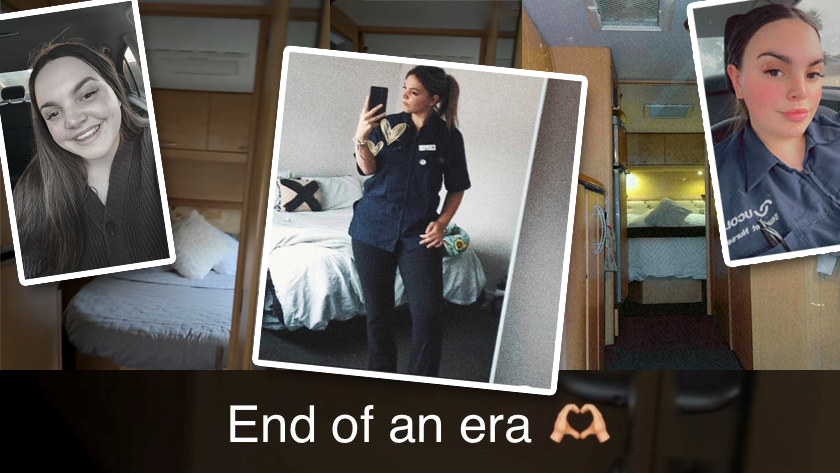
“It was so cold — I had a diesel heater but it really stunk and I just couldn’t handle that so I got two hot water bottles and four blankets and just hoped for the best,” she told Kaitiaki.
Foxton-based Hofman had to live in a caravan for nine weeks because her final general practice clinical placement was a two-hour round trip away, in Whanganui. The only other option had been Auckland — even further away. So she asked family friends who lived in Whanganui if she could put her sister’s caravan on their front lawn for two months. They said yes.
“I don’t want to travel that much. I went home at weekends, but in the week I stayed in the caravan — but I got really sick.”

Hofman had to empty the toilet each day, but was able to shower and eat meals inside their house.
Towards the end of the nine-week placement she came down with a cold, which became influenza and then a sinus infection, which is still lingering.

“It was just a really bad time,” Hofman told Kaitiaki, still sounding very under the weather. “It was my birthday, I came home. I’ve been sick on and off since then.”
The experience meant Hofman had to sit her registered nurse (RN) state exam final last week while sick, leading to high anxiety. “I hope I haven’t mucked it up — I’m very worried about it.”
‘I want to apply the skills that I’ve learnt and not lose them.’
She is one of 964 nurses (RNs and ENs) who graduated this month vying for just 428 new graduate RN roles currently available at Te Whatu Ora-Health NZ (HNZ).
Hofman — who has a $70,000 student loan — said it was tough after working so hard for so long to be faced with an uncertain future and possible lengthy wait for work.

“How are we supposed to have experience if you’re not going to hire a new grad?” she said. “I want to apply the skills that I’ve learnt and not lose them – I want to get in straight away.”
Primary vs hospital
Hofman was quite keen on exploring primary health because of the range of work they could experience there.
“I really enjoyed it because I feel like you learn a lot about different conditions and you’re constantly learning,” she said.
“In the hospital, it’s very fast-paced and you don’t always consolidate what you’re doing — you’re just delegated to do it.”
She was waiting to see if she passed her state final exam before applying for work, but estimated about half her classmates were applying for primary or community roles.
“As a new grad, I think there’s a fear of being put under pressure because there are . . . bad staff shortages there [in hospitals].”
However, even PHC advertisements were mostly seeking experienced RNs and vaccinators.
UCol is one of a handful of schools, primarily polytechnics, which run mid-year nursing intakes at their Palmerston North and Whanganui campuses.
Placements ‘huge challenge’
NZNO’s national student unit co-leader Poihaere Whare said clinical placements were a huge challenge for students, logistically and financially — especially the final one which could be as long as 12 weeks.
“This is why students do what they have to do — stay in a camper van, or sleep in a car,” she said.

Whare said she had been prepared to sleep on an airbed in the back of her car if her placement had been far away — but in the end, didn’t need to.
“We have to do what we have to do. Sometimes it means travelling — forward and back, forward and back — and that’s another cost with petrol prices.”
Some form of financial support for students on placement would make a huge difference, Whare said.
Her own school, Te Whare Wānanga o Waikato — University of Waikato, was really good at communicating with students at the beginning of year three to find out if they had whānau to stay with on out-of-town placements.
Schools acknowledge placement challenges
Heads of school at the NZNO national student hui earlier this month talked about the challenges of placements — for example there are just five mental health placements in Wairarapa so all the other students have to go to Wellington.
Students in Palmerston North — which has two nursing schools — are often sent to Dannevirke, Levin, Kāpiti or Whanganui for placements.

One South Island nursing school recently sent students to Wairarapa and Hawke’s Bay for placements. While transport and accommodation were supplied, it meant students were away from home for six weeks.
Nursing exam results are out on August 6.
HNZ has said there will be 1800 jobs available for graduates over the 2026/27 financial year — a job rate of about 60 per cent.