


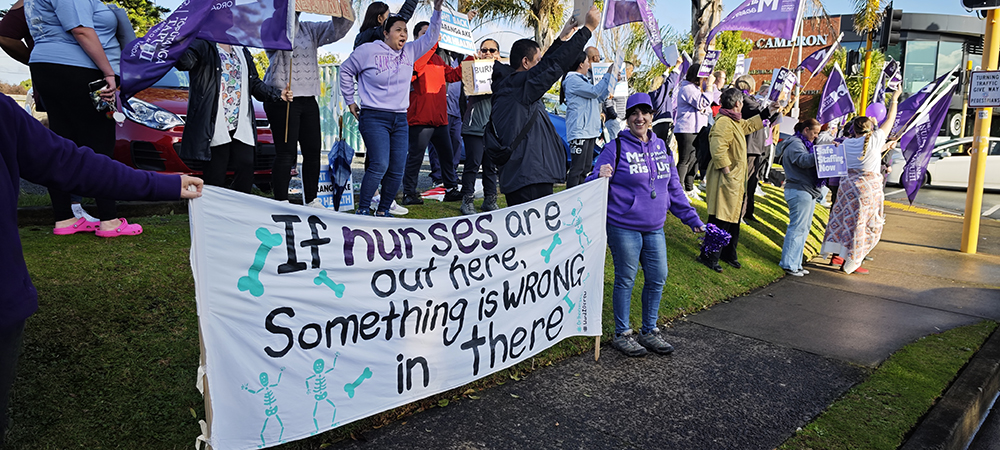
Fed up after years of trying to get nurses’ staffing fears taken seriously, NZNO safe staffing coordinator Maree Jones tackles some of Te Whatu Ora’s ongoing claims that its hospitals are safe — despite damning evidence to the contrary.
NZNO strategic researcher Nathalie Jacques fought for a year to get Te Whatu Ora’s 2024 figures on how many shifts were below safe staffing targets.
But only after she successfully appealed to the Ombudsman, did they reveal the truth — that more than half of all hospital day shifts were understaffed last year.
And most acute and forensic mental health units? Almost always.

Hot on the heels came more damning evidence — a new report showing that the country’s hospitals were on average short nearly 600 nurses per shift last year.
Despite such damning figures, Te Whatu Ora leaders are still pretending it’s not happening and the figures are “misleading”. This is the ultimate in gaslighting, says NZNO’s safe staffing coordinator Jones.
Tōpūtanga Tapuhi Kaitiaki o Aotearoa-NZNO also wants Te Whatu Ora to work with NZNO to research the introduction of staff-to-patient ratios alongside CCDM, to support safe staffing into the future.
Here, Jones clinically dismantles some of Te Whatu Ora’s claims:
| What Te Whatu Ora is saying | Nurses’ reality |
|---|---|
| They are ‘sorry’ that nurses feel exhausted and burnt out.
“I am sorry they feel that way.” – Richard Sullivan on RNZ, September 2. |
This indicates Te Whatu Ora has little knowledge of how nurses working for Te Whatu Ora-Health New Zealand feel about their work and conditions.
Te Whatu Ora does not routinely survey nurses for job satisfaction, burnout, wellbeing and intent to leave the profession. Yet safe staffing tool CCDM (care capacity demand management) requires that the nursing staff are surveyed every three months. It is international best practice to do this every three to six months, share results transparently and act on them — staff lose trust when feedback disappears into a void. |
| The country’s hospitals are not understaffed.
“Using this data in isolation to claim that wards are understaffed and unsafe is misleading.” — TE Whatu Ora national clinical director Richard Sullivan. (Media release, September 1) |
Te Whatu Ora does not collect the best evidence and data to inform them if understaffing is occurring or not.
Yet there is a flood of information available on nurse understaffing from the clinical floor every shift via the CCDM system. Its variance response management (VRM) flags when there is a mismatch between patient demand and staff capacity. Te Whatu Ora does not collect, report nor analyse this information in a standard way across New Zealand. If it invested in a national data system, it could collect this. It could also collect data showing how many valid requests for staff for every ward are made every shift. Without this national data, there is a gap in Te Whatu Ora’s ability to respond. Nurses have become increasingly sceptical of the effectiveness of the VRM system due to lack of response by their employer when they indicate staffing pressure. |
| Shifts-below-target is a “moment in time measure, that is often capturing just five minutes of an eight-hour shift. Using this data in isolation to claim that wards are under-staffed and unsafe is misleading”. — Richard Sullivan (media release, September 1) | Shifts-below-target is calculated by the VRM system.
Research clearly tells us insufficient staff puts patients at risk. Shifts-below-target should always be measured in real-time. But this requires clinical nursing staff and shift leaders to update the data tool, TrendCare, not only at both ends of the shift but also during the shift when patient acuity, numbers and/or staffing numbers change. TrendCare can then automatically calculate staffing shortfalls using this live data. This ideal practice would provide:
Why it matters
|
| Te Whatu Ora prefers to use clinical outcomes such as falls, pressure injuries, hospital-acquired infections and inpatient deaths to measure if patients are safe. (Media release, September 1) | All of these are “sorry” measures — they measure preventable harm.
Reports of preventable harm diminish patient and public trust and cause emotional harm to clinical nurses. CCDM has a built-in early warning system — VRM is designed to trigger action before patients suffer harm. Why is VRM better at keeping patient safe? Proactive: It allows the calling in of reinforcements, reallocation of staff or escalation to leadership before the situation becomes unsafe and/or causes patient harm. Standardised decision-making: Everyone follows the same playbook, reducing confusion and delays. Staff wellbeing: Prevents burnout by avoiding chronic overload. Patient safety: Ensures care quality doesn’t drop when things get busy. Relying solely on falls, pressure injuries, hospital-acquired infections and death can be problematic for the following reasons: Retrospective, not preventative
Hard to determine the cause of the harm
Under-reporting and data quality
Doesn’t reflect near misses or unsafe conditions
Delay in feedback
|
| “There are now more nurses working in our hospitals than ever before.” — Richard Sullivan, media release, September 1. | A growing and ageing population is bringing more patients and more complex conditions into hospitals.
It is only logical that hospital nurse staffing needs to keep pace. However, this does not mean nurse staffing matches patient demand. Only the data from an accurate safe staffing system can show that. |
| On CCDM acuity tool TrendCare:
“We don’t believe the current tool . . . is fit-for-purpose.” — Richard Sullivan, media release, September 1. |
TrendCare is an acuity tool.
Acuity tools turn the complex, often invisible work of nursing into quantifiable, visible, actionable data that reflects what is actually happening on the ward. Having acuity data is vital now that nurses are no longer is in charge of the nursing budget. The nursing budget is now overseen by accountants who often do not understand nursing. TrendCare and CCDM are absolutely fit-for-purpose. The tools provide data from nurses which informs the organisation how many nursing hours are necessary to keep patients safe and well. Only nurses are qualified to do this. The goal of CCDM is to move away from making rosters fit budgets, and instead build budgets around actual care demand. Together TrendCare and CCDM deliver:
|
| “. . . in fact, no other country uses this tool as a national tool anymore . . .” – Richard Sullivan, RNZ, September 2.
|
Other countries that use TrendCare
Australia – Where TrendCare originated and is widely adopted across public and private hospitals. Southeast Asia – TrendCare has been trialled and validated in various health-care facilities across the region. TrendCare is considered a gold standard in acuity-based staffing in the southern hemisphere. Countries using similar patient acuity systems to CCDM for staffing and budgeting:
Pilots or partial adoption:
|
| “CCDM’s not going anywhere, and I’m really excited to think about its future direction.” — Te Whatu Ora chief nurse Nadine Gray to Kaitiaki February, 2025.
|
“We don’t believe the current tool . . . is fit-for-purpose.” — Richard Sullivan, RNZ, September 2. |
| ” . . . we are working to employ as many graduates RNs as possible”. — Nadine Gray on RNZ, July 2025. | Te Whatu Ora has employed just 45 percent of mid-year graduates.
Te Whatu Ora previously committed to explore employing all new graduates in the 2018 safe staffing accord with NZNO. Recently, it has also:
|