


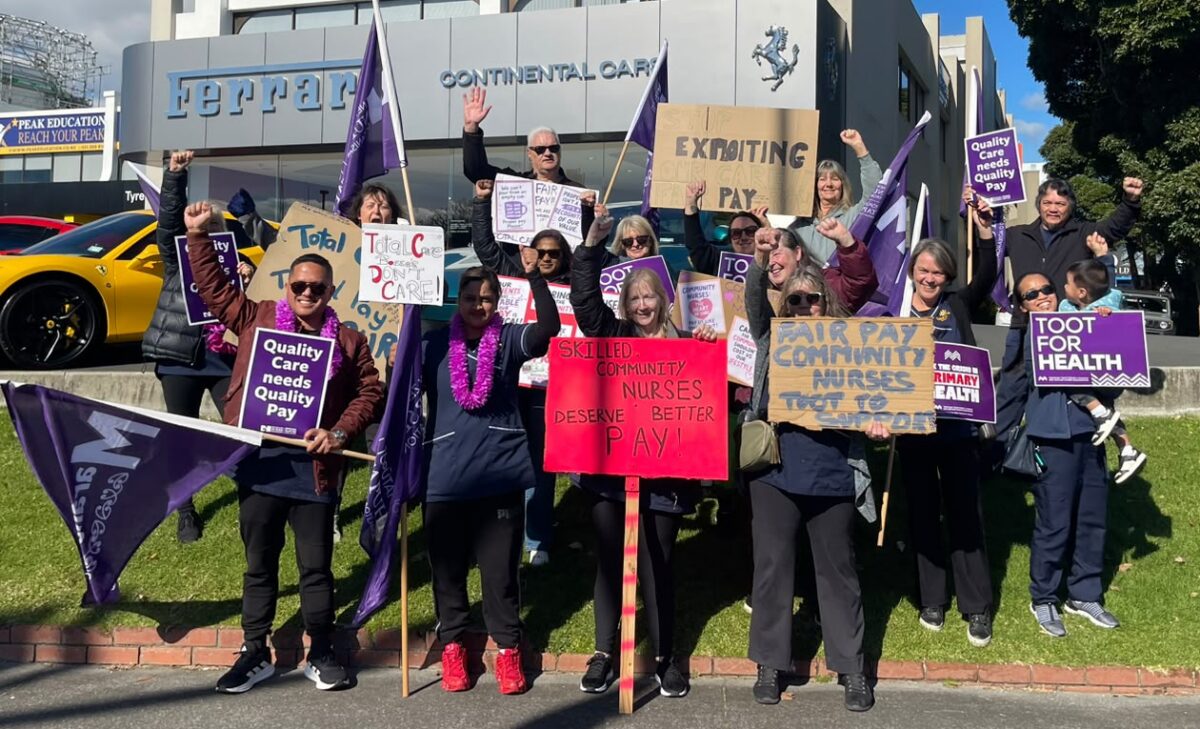
More than 50 NZNO members, some of the lowest-paid community nursing workers in the country, gathered at picket lines across the North Island to strike this month.

They work at Total Care Health, an ACC-funded specialist mobile nursing service that, despite the pay, makes high demands on staff experience, skill and nursing instinct.
As members mull their next steps in bargaining, Kaitiaki spoke to some of those who joined the picket lines — sharing what it takes to work a day on the road and in patients’ homes and lives.
NZNO delegate Stephanie Waite (speaking below in the video) is in Auckland where she’s just driven from the fringe of Otāhuhu and Mt Wellington, down to Manurewa, then back up to Botany, for clients.

“That’s huge mileage to cover.”
Waite is in her seventh year as a clinical nurse leader, her eighth as a delegate, her eleventh with the company, and her 20th working as a district nurse or variation thereof (“We do pretty much what a district nurse does, but it’s all injury or private care related.”).
On any given day, in the background, she might also have to arrange staff education, induct new nurses, complete administrative work, or liaise with case managers.
Time behind the wheel is part of the job. There was a nurse just recently, says Waite, who was on the road to scheduled clients when she was diverted on an about-40 minute journey to help ambulance staff change a catheter (they weren’t trained for it). The catheter was blocked, a serious problem for the tetraplegic patient with a condition that could send his blood pressure dangerously high.
Waite and her colleagues might have to complete their notes in their car, whether in the summer heat or busy streets. There’s not enough time allotted for travel, she says, and they have to “quibble” over overtime.
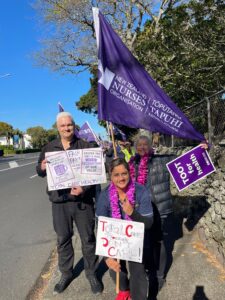
They deal with complex demands like those from pelvic and hernia mesh injuries.
“We’re becoming more specialised in managing the wounds caused by the mesh and also the continence issues that come with it. So we need to have the knowledge of managing stomas and catheters and troubleshooting.”
Waite loves her work, she loves the clients and their whānau, and she loves the flexibility of community nursing. But not so much her pay.
They’re far behind Te Whatu Ora-Health NZ (HNZ) workers and only getting further behind, she says. “A level 7 nurse base salary in the hospitals is $107,000. I’m currently on $96,500 as a clinical lead.”
As if to prove her point about an ever-growing gap, under the new HNZ collective a grade 7 registered nurse (RN) now actually gets paid $109,407 — rising to more than $111,000 next year.
This job demands experience
NZNO delegate Mark Wiggins is grateful to have Waite as his clinical team leader — she’s “brilliant”, “invaluable”, and underpaid for the work she does.
Wiggins should know — he’s been a nurse for 35 years and every day on the job, he says, is a consolidation of everything he’s learnt up to this point. This job demands experience.
“You work in isolation, you’ve got your colleagues on the end of the phone, but you’re not going in just for a wound. A wound’s attached to a whole person, and it exists because of that person.”
It could be skin tears, or maybe someone’s fallen over, or dog bites, right up to massive wounds from burns. It ranges in ages as well — from littlies to seniors.
Because they deal with cases covered by ACC, many of the people the nurses see are considered serious injury clients. These are people who have paralysis of different levels. Paraplegics, quadriplegics and tetraplegics.
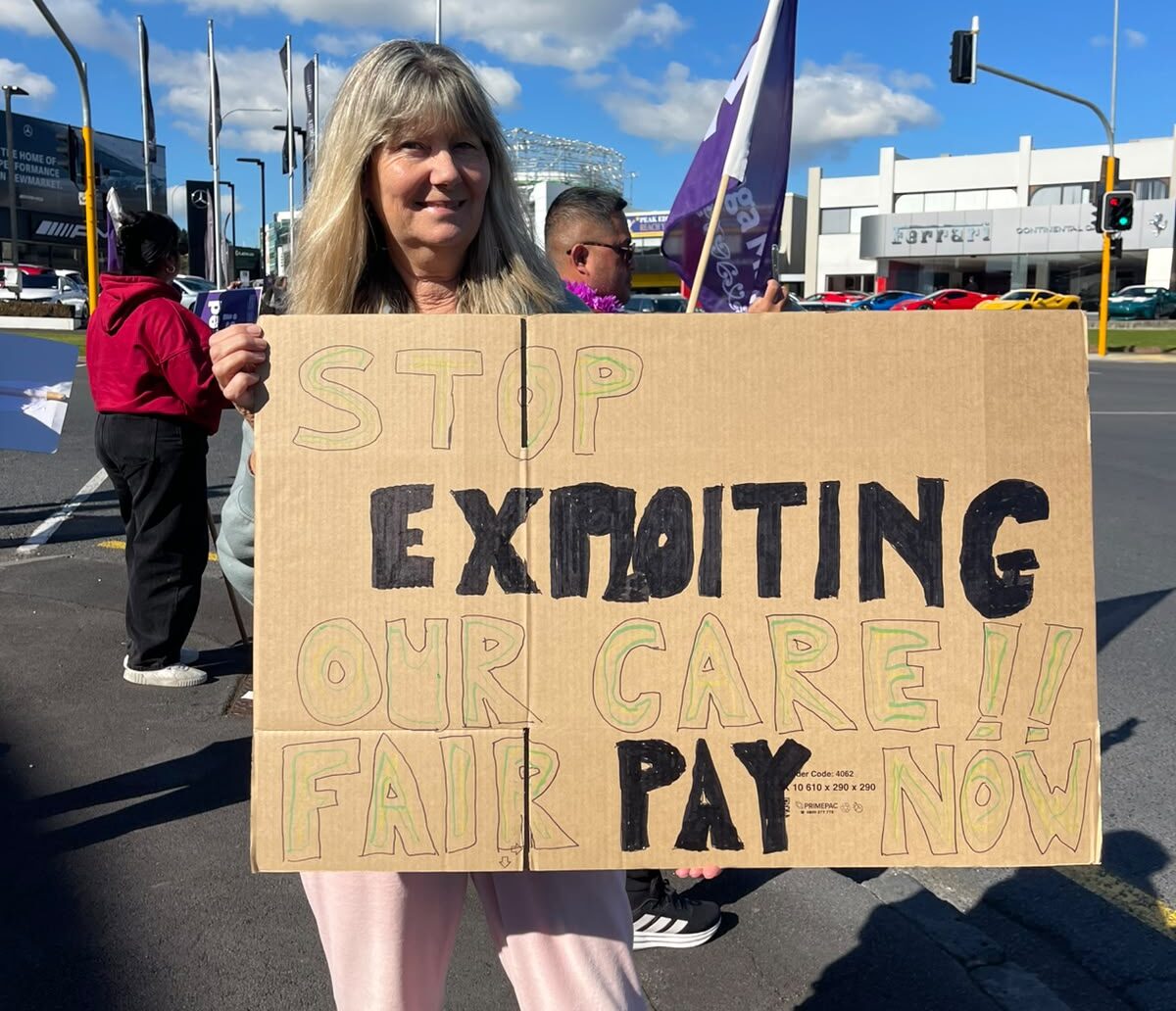
“We’ll go in to them and we’ll do urinary catheters, unfortunately they’ll get some wounds, they’ll get pressure sores that we’ll go in and support. There’s also supplies they’ll need for their cares.”
Wiggins has worked with Total Care for seven years now after spells as a district nurse in Auckland and Counties Manukau, and working as a clinical nurse specialist for burns at Middlemore Hospital. He came to New Zealand 20 years ago from the UK and he can’t believe two decades — a whole lifetime — have passed.
Now he’s on the NZNO bargaining team (“it’s not an easy thing”), and was pleased with the strike. It was the first time he’d ever really taken part in any action like it.

When people are already on low wages it gets harder to motivate them to take unpaid time off, he says — but there was strong support from the members. “It’s the most and highest votes that we’ve had for any action that we’ve taken.”
Overall the way health care is funded probably needed to be reprioritised — with more focus on primary care to ease the pressure on hospitals, he says.
“You can build as many hospitals as you like, but you don’t need to fill ’em. The idea is not to.”
Speaking of funding priorities, another NZNO non-delegate member who Kaitiaki has chosen not to name, has been nursing for nearly two decades, but is paid the same as a third-year nurse in HNZ.
She used to work in hospitals but took up community nursing, as a working mum, for increased flexibility and no shift work. She knew it would mean a pay drop: “But why do we have to take such a massive pay cut to be able to take care of our families? I’m as qualified as a hospital nurse, as any other nurse, yet I get paid a pittance in comparison. It’s pretty frustrating.”
The company relies on her experience, education and her gut instinct, she says. When she walks into someone’s home, she’s there by herself and it’s not just treating a wound: That wound could turn into cellulitis, a serious skin infection, which then could turn into sepsis — a life-threatening immune reaction — or even gangrene.
“Numerous times I’ve walked into a house and I’m going for the wound and I’ve looked at the person and thought ‘oh, you’re not ok’ and shipped them off to hospital.”
‘I’m as qualified as a hospital nurse, as any other nurse, yet I get paid a pittance in comparison. It’s pretty frustrating.’
Other times she’s visited homes with people wearing ankle monitors and she doesn’t know why, or there’s people there who are “not very pleasant”, she says, but at the end of the day she’s a nurse with a duty of care.

The Total Care members might not have that massive march in the cities with thousands of people, “but it was good to see that the majority of our members were out there”, she says.
If there were no nurses then there would be no company or contracts or work being done, she says. “So how we can be the least valuable members of a team when we literally are the business is amazing.”
The path ahead
- Bargaining for Total Care Health members goes into mediation on August 27.
- A member survey on further steps wrapped up on August 19.
- There have been two rejected Total Care offers — 2.5 per cent over 13 months; then a two-year agreement with three per cent initially and 2.5 per cent in a year.
- However, staff are seeking parity with NZNO members at sister service Access Community Health who accepted a hard-fought offer in April including a professional development and recognition programme (PDRP).