


About the authors:Arshi Nadeem is a final-year student in the master of nursing science programme at the Centre for Postgraduate Nursing Studies, University of Otago, Christchurch. David Healee, RN, DHSc, MA(appld nsg), ONC (UK), MCNA (NZ), is a senior lecturer in the Centre for Postgraduate Nursing Studies, University of Otago, Christchurch. This article was accepted for publication in September 2021. |
ABSTRACTBackground: Pressure injuries are an indicator of quality of care, and are associated with decreasing quality of life for patients, and increased recovery time. The Waterlow scale is a recommended tool in many international guidelines for pressure injury prevention. Aim: The aim of this literature review was to explore the effectiveness and validity of the Waterlow scale in acute care settings for the prevention of pressure injuries. Method: Six electronic databases were searched: CINAHL EBSCOhost, Ovid Embase, Ovid Emcare, Ovid Medline, The Cochrane Library and Ovid Nursing Database. Eleven studies were identified for inclusion in the review. A thematic approach was used to synthesise the information. Findings: Three key themes were identified: “validity and reliability”, “clinical judgment” and “feasibility and cost implications”. Ten out of the 11 studies indicated poor reliability and validity. Using this scale in conjunction with clinical judgement is highly recommended for best practice. Although the Waterlow scale was found to be easy to use, it may not be economical due to its tendency to overpredict the risk. Conclusion: The Waterlow scale shows poor reliability and validity in assessing pressure injury risk in acute settings. It should only be used in conjunction with clinical judgement for initial screening. Educating and training nurses to use it effectively can increase its reliability over time. Despite its limitations, the Waterlow scale is the most widely used scale in clinical practice. Further research is recommended to test the scale in acute care settings. |
||
KEYWORDSpressure injury, Waterlow scale, reliability, validity, effectiveness, clinical judgment |
|||


INTRODUCTION
PRESSURE INJURIES (PIs) cause significant clinical problems in health-care facilities worldwide, and are responsible for considerable morbidity and mortality (Webster et al., 2010). Although preventable, they have always been present and are an important indicator of quality of care (O’Tuathail & Taqi, 2011; Serraes et al., 2018). Various studies conducted in the United States (US), Canada, and Europe reported the prevalence range of PI from 5 to 26 percent (McInnes et al., 2015). The annual cost of managing PIs is estimated to be UK£2.1 billion in the United Kingdom, A$1.8 billion in Australia, and about US$3.6 billion in the US. In New Zealand, the annual cost is estimated to be NZ$694 million (Rodgers et al., 2020).
In acute settings in an Australian study, the incidence of PI was found to range from 2.9 to 32.4 percent (Webster et al., 2010). Screening patients for risk factors is a long-standing and successful approach to preventing PI (Webster et al., 2010). In clinical areas, risk assessment scales (RASs) such as the Waterlow scale, Braden scale and Norton scale are widely used to measure PI risk and have been subjected to many studies to assess their validity (Anthony et al., 2010). Evidence suggests that RASs such as the Waterlow scale do identify patients at risk (Anthony et al., 2010). However, despite the ability to predict risk, there is not enough evidence showing the Waterlow scale’s effectiveness in reducing PI incidence in acute settings (Anthony et al., 2010).
This article aimed to review the literature describing the effectiveness of the Waterlow scale in identifying patients at risk of PI in acute settings.
BACKGROUND
PIs are preventable but are still an ever-growing problem for the health-care sector worldwide. They are caused by “localized damage to the skin and/or underlying tissue mainly over bony prominences due to constant pressure or shear or both” (McInnes et al., 2015, p.3), and are known as “pressure sores, pressure ulcers, bed sores, and decubitus ulcers” (McInnes et al., 2015, p.3). From 2016 onwards, the US National Pressure Injury Advisory Panel (NPIAP) staging system replaced the word “ulcer” with “injury” to reflect the characteristics and aetiology of pressure injuries (Edsberg et al., 2016).
Patients admitted to intensive care units (ICU) are at higher risk of PI, compared to other patients (Kottner & Dassen, 2010). Prevention is the best approach to addressing the problem of growing incidence of PI (Mahalingam et al., 2014). Prevention measures should focus on identifying risk factors and tailoring interventions (Serraes et al., 2018). Assessment is the key. Nurses have an important role in assessing and identifying patients at risk and implementing prevention measures (O’Tuathail & Taqi, 2011). NPIAP, the European Pressure Ulcer Advisory Panel (EPUAP) and the Pan Pacific Pressure Injury Alliance (PPPIA) recommend using a structured approach, tailored to changes in a patient status (Alderden et al., 2020). In clinical settings, risk assessment is performed using screening tools such as the Braden scale, Norton scale or Waterlow scale. However, NPIAP, EPUAP and PPPIA also recommend a risk-based prevention approach rather than solely relying on a screening tool (Alderden et al., 2020). Nevertheless, using tools in PI prevention is crucial due to their ability to screen patients to ensure appropriate care and that measures are taken to alleviate risk (Walsh & Dempsey, 2011).
There are 40 RASs currently in use, based on seminal work from the 1980s. Most of them have not been frequently validated by controlled trials, but are widely used in acute care settings (Kottner & Dassen, 2010; Moore & Patton, 2019; Webster et al., 2010). An ideal RAS should have both good validity and reliability, or inter-rater reliability, to determine if it is suitable to measure a particular variable (Wang et al., 2014). The Waterlow scale is most widely used in clinical practice (Moore & Patton, 2019). It was developed by Judy Waterlow in 1980s (for educational purposes) from a survey undertaken among elderly patients and in acute settings (Webster et al., 2010). In the Waterlow scale, patients can be grouped into three risk categories according to their score – at risk (10-14), high risk (15-19) and very high risk (>20) (Borghardt et al., 2015; Tannen et al., 2010). The higher the score, the higher is the risk of developing a pressure injury (Borghardt et al., 2015; Tannen et al., 2010). A revised Waterlow scale considered factors such as height and weight for body mass index (BMI), skin assessment, continence, mobility, nutrition, medication, tissue malnutrition, neurological deficits, major surgery or trauma, and demographic details (gender, sex, age) (Charalambous et al., 2018).
According to the New Zealand Health Quality and Safety Commission (2018), about four to eight percent of all hospitalised patients develop PIs, with 40 percent of these patients suffering a stage three or stage four PI. Despite continuous efforts to raise awareness and reduce PIs in New Zealand, it was noted that between 2009 and 2016, claims related to PI increased by 63 percent (Accident Compensation Corporation [ACC], 2017).
REVIEW AIM
This review aimed to explore the effectiveness and validity of the Waterlow scale for risk assessment of PIs for patients in acute settings. This may add to the knowledge about the utility of the Waterlow scale, which, in turn, may help to introduce preventive measures early and reduce costs by using available resources appropriately.
METHOD
A search was conducted using CINAHL EBSCOhost, Ovid Embase, Ovid Emcare, Ovid Medline, Cochrane Library and Ovid Nursing databases. Search words included “pressure ulcers”, “pressure sores”, “pressure injury”, “decubitus ulcers”, “risk assessment”, “Waterlow scale”, “prevention” and “effectiveness”. Only peer-reviewed journals were searched, and no limitation was set for type of study. A total of 472 articles were found. From these, 462 remained after removing duplicates; 433 articles were then removed after applying criteria of a 2010-2020 date range and English language. Although limited articles were found related to the review question, date range was not broadened. Systematic reviews were included to increase the amount of information. After reviewing the title, key words and abstracts, 11 articles were included in the review.
A thematic analysis approach, developed by Braun and Clarke (2013), was used to analyse the data. This approach involved six key stages: familiarisation with the data, generating initial codes, searching for themes, reviewing for themes, defining and naming the themes, and producing the report.
FINDINGS
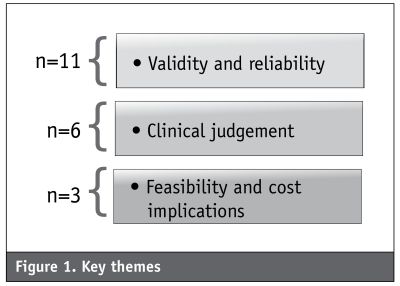
Three themes were generated from the analysis: “validity and reliability”, “clinical judgment”, and “feasibility and cost implications”. These themes, shown in Figure 1, are interconnected.
Theme one: Validity and reliability
The first theme relates to looking at the validity and reliability of the Waterlow scale to analyse its effectiveness. Three observational studies (Kottner & Dassen, 2010; Tannen et al., 2010; Wang et al., 2014) evaluated the validity and reliability of the Waterlow scale by comparing it with other RAS scales such as the Braden scale, the Norton scale, the visual analogue scale and the care dependency scale. Kottner and Dassen (2010) compared the inter-rater reliability and construct validity of the Waterlow scale and the Braden scale in intensive care units (ICUs) (n=45) in Germany. They recruited 45 patients. The intra-class correlation coefficient (ICC) was used to determine inter-rater reliability. The Waterlow scale sum score, ICC=0.36 (95% CI 0.09-0.63), was lowest among the RASs (Kottner & Dassen, 2010). Variance of 41 percent to 74 percent was found, suggesting lower inter-rater reliability and validity of the Waterlow scale, compared to the Braden scale (Kottner & Dassen, 2010).
Tannen et al. (2010) collected data through standardised questionnaires across multiple acute settings (n=1053) in Germany, comparing the predictive validity and inter-rater reliability of the Waterlow, Braden and care dependency scales. They showed the Waterlow scale scoring less than 70 percent for specificity and sensitivity, the lowest of the RASs, thus failing to achieve the minimum requirement. With a cut-off point of 8, it also showed poor validity. In contrast, Wang et al. (2014), in their observational study in China across multiple acute care settings (n=23), found inter-rater reliability of the Waterlow scale was substantial, but it still had low reliability for some items on the scale. Wang et al. (2014) recommended development of a new evidence-based RAS and advised caution in using Waterlow in clinical practice.
Two cohort studies (Borghardt et al., 2015; Kumari et al., 2015) compared the predictor validity, specificity and sensitivity of the Waterlow scale with the Braden and Norton scales. Borghardt et al. (2015) evaluated a cohort of patients (n=55) from two different ICUs in the same hospital in Brazil. The receiver operating characteristic curve (ROC) was used to determine the sensitivity and specificity of each scale to determine the predictor validity. The Waterlow scale demonstrated sensitivity of 71 percent and specificity of 47 percent, which was higher than the Braden scale (Borghardt et al., 2015). Most of the patients who developed PIs in their study were identified as “high risk” on the Waterlow scale.
However, the second prospective cohort study (Kumari et al., 2015), conducted in India among surgical patients (n=100), did not recommend the Waterlow scale be used in acute-care settings. The researchers assessed patients admitted within the previous 24 hours without pre-existing PIs with the Waterlow scale, the Braden scale and the Norton scale. On evaluation, the Waterlow scale scored the lowest cut-off point, compared to the Braden and Norton scales (Kumari et al., 2015). The ROC curve plot was used to assess the predictive validity of each scale. The Norton scale showed very high sensitivity of 95.6 and high specificity of 93.5, whereas, the Waterlow scale was the lowest, providing adequate sensitivity of 91.3 and specificity of 84.4 (Kumari et al., 2015). Similarly, a third prospective cohort study (Webster et al., 2010) screened patients (n=23) with the Waterlow scale across acute care in a tertiary hospital in Brisbane. They concluded that the Waterlow scale had poor predictive validity and was not recommended for use in acute care (Webster et al., 2010). They recommended evaluation of the Waterlow scale alongside other RASs and clinical judgment, by randomised controlled trial (RCT), for an accurate and generalisable result.
The above findings are supported by four systematic reviews (Charalambous et al., 2018; Chou et al., 2013; Moore & Patton, 2019; O’Tuathail & Taqi, 2011). These reviews focused on studies assessing the reliability and validity of the Waterlow scale in acute-care settings, mostly in ICUs. They concluded that the Waterlow scale was a weak predictor of PIs for patients in acute care. An RCT (Webster et al., 2011) was conducted in Australia with patients (n=1231) across multiple settings that compared the Waterlow scale (n=410), the Ramstadius scale (n=411) and clinical judgment (n=410) for effectiveness. The main purpose of this study was to assess the incidence of hospital-acquired PIs; however the trial found no evidence that suggested the Waterlow scale was superior in reliability or validity (Webster et al., 2011).
Theme two: Clinical judgment
The second theme relates clinical judgment and its relationship with the outcome of the screening. One observational study (Kottner & Dassen, 2010) and one cohort study (Webster et al., 2010) concluded that assessment skills of nurses were superior to any RAS used in acute care. Kottner and Dassen (2010) created artificial written scenarios to compare nurses’ clinical judgment, based on a score from 1-10, with the Waterlow scale and another RAS. Nurses’ clinical judgment better matched reference standards than did the standardised scales (Kottner & Dassen, 2010). In addition, Webster et al (2010) demonstrated that basic nursing assessments, such as regular skin checks and monitoring of nutrition and hydration levels, mobility status and friction and shear were the important markers of PI risk. Similarly, results from the Webster et al (2011) study, done in an acute setting, found no evidence that suggested the Waterlow scale was better than clinical judgment in assessing and preventing PIs. They carried out a RCT at a tertiary hospital in Australia among 1231 patients from medical and oncology wards. They recommended assessing for specific PI risks and skin inspections, rather than relying on RASs.
These findings are further substantiated by three systematic reviews (Chou et al., 2013; Moore & Patton, 2019; O’Tuathail & Taqi, 2011) which concluded that the Waterlow scale and other RASs were no better than non-standardised risk assessment based on nurses` clinical judgment.
Webster et al (2010) in their cohort study collected data from patients (n=247) through trained nurses. They found nurses were prepared to modify the final score of the Waterlow scale based on their assessment of what the patient needed. For example, they would judge whether a patient needed a special mattress or overlay on the basis of their mobility, level of activity, skin issues and nutritional status, rather than the Waterlow result. Webster et al (2011) found the poor predictability of the Waterlow scale was due to the inability of nurses to calculate body mass index (BMI) – this was an important component of the Waterlow scale, but was rarely calculated (Webster et al., 2010). Kottner and Dassen (2010), in their correlation study among critically ill patients, found a variation of 60 percent between RAS scores and risk estimates by nurses using their clinical judgment.
Theme three: Feasibility and cost implications
The third theme relates to the feasibility of using the scale in clinical settings. Two systematic reviews, O’Tuathail and Taqi (2011) and Moore and Patton (2019) discussed the cost implications of relying on the Waterlow scale, owing to its poor specificity and sensitivity. Their reviews highlighted the additional burden on health-care costs due to Waterlow over-predicting risk. This resulted in unwarranted allocation of resources and staff time being wasted.
Feasibility was an important factor influencing the use of standardised RASs in clinical settings (O’Tuathail & Taqi, 2011). Two systematic reviews (Charalambous et al., 2018; O’Tuathail & Taqi, 2011) found that the Waterlow scale was easy to use, compared to other RASs. O’Tuathail and Taqi (2011) also noted that the Waterlow scale was ambiguous and time-consuming, as it involved reading patients’ charts to obtain scores for some components of the scale. Familiarity with RASs was another factor to consider when assessing ease of use, as some nurses might find a particular scale easier to use due to previous experience with it (O’Tuathail & Taqi, 2011).
DISCUSSION
The purpose of this review was to assess the utility of the Waterlow scale in reducing the incidence of PIs in acute care. This review found the Waterlow scale might not be a reliable screening tool for PI risk assessment in acute-care patients. The three main factors identified included: insufficient validity and reliability, the importance of nurses’ clinical judgment, and feasibility and cost implications related to use of the Waterlow scale. Effectiveness of any RAS is assessed in terms of its validity and reliability (Satekova et al., 2017). Walsh and Dempsey (2011) stated that it was highly unlikely for a patient to be assessed by the same nurse each time and variability could also occur due to differing levels of knowledge among different nurses. Therefore, any RAS had to be reliable “regardless of the assessor” (Walsh & Dempsey, 2011, p. 201).
In this review, many studies identified the poor predictive validity and reliability of the Waterlow scale (Borghardt et al., 2015; Charalambous et al., 2018; Chou et al., 2013; Kottner & Dassen, 2010; Kumari et al., 2015; Moore & Patton, 2019; O’Tuathail & Taqi, 2011; Tannen et al., 2010; Wang et al., 2015; Webster et al., 2010). Lack of knowledge about the validity and reliability of any RAS has far-reaching implications for clinical practice and patient safety (Moore & Patton, 2019).
The recommendation to use the Waterlow scale in conjunction with nurses’ clinical judgment arose often in the reviewed studies. Several studies concluded that nurses often use their clinical judgment when assessing PI risk (Chou et al., 2013; Kottner & Dassen, 2010; Moore & Patton, 2019; O’Tuathail & Taqi, 2011; Wang et al., 2014; Webster et al., 2010, 2011). Nurses’ clinical judgment plays a key role in assessing and screening patients for PI risk (Webster et al., 2011). Using clinical judgment is defined as “knowing why an intervention is needed and how to perform it competently” (Standing, 2008, p. 125). Using Waterlow and other RASs in conjunction with clinical judgment can predict risk better and reduce the incidence of PIs (Webster et al., 2011).
According to Balzer et al. (2014), nurses consider various patient characteristics and regard some conditions as more important than others for PI risk assessment. Nurses make their assessment based on patient acuity and impairments, which are well-known aetiological factors. However there is a lack of consensus on which variables are more important risk factors, which can vary depending on the clinical settings (Moore & Patton, 2019). Borghardt et al. (2015) argued that the incidence of PIs in ICUs with critically ill patients was significantly higher than in other acute settings due to patient dynamics, leaving little value for the Waterlow scale. Wang et al. (2014) demonstrated, through sub-group analysis, that inter-rater reliability of some elements of the Waterlow scale was poor. For example, activity could not be assessed for orthopaedic and spinal injury patients, nutritional status and continence for neurology and neuro-surgery patients, and assessment of skin type in the cardiothoracic surgical unit (Wang et al., 2014). The complexity of the scoring system and manipulation of the score by nurses on the basis of their clinical judgment reflected its limitations (Webster et al., 2010). Thus, the PI risk status of a patient might be influenced by the clinical judgment of the nurse using this scale (Walsh & Dempsey, 2011). Hence, it is imperative to research nurses’ perceptions, to identify which patient characteristics inform their clinical decisions for PI risk assessment.
Literature suggests that the Waterlow scale has a tendency to over-estimate risk (Webster et al., 2010). Consequently, PI prevention interventions are carried out for patients not at risk and conversely, others who need them are not receiving them (Moore & Patton, 2019). This causes pressure on health-care budgets and resources such as staff time and equipment (O’Tuathail & Taqi, 2011; Moore & Patton, 2019). For example, several patients may be given pressure-relieving equipment such as mattresses and cushions for longer than required, with the result that others miss out on these interventions.
Two studies suggested that the Waterlow scale was time-consuming, even though it was easier to use than other RASs (Charalambous et al., 2018; O’Tuathail & Taqi, 2011). Although considerable time and resources are wasted by nurses completing the Waterlow scale and other RASs, any scoring method cannot replace comprehensive nursing assessment, ongoing observation and patient-centred care plans (Borghardt et al., 2015; Moore & Patton, 2019; Webster et al., 2011). Borghardt et al.(2015) suggest using the Waterlow scale only to support documentation of elements favouring PI development. These authors also suggest trialling the scale with larger samples for better determination of its validity and predictability for a chosen population. Using a multi-disciplinary approach is recommended to identify and manage PI risk factors and provide quality care (Moore & Patton, 2019). Nursing assessment is one of the major roles of nurses and using assessment tools correctly is crucial (Bell, 2018). Nurses must be able to understand PI risk factors, know how to use assessment tools and use the right one for acutely ill patients, and implement interventions when risk is identified. Further research is needed comparing the usefulness of the Waterlow scale with other RASs and with clinical judgment in acute-care settings.
CONCLUSION
Prevention of PIs is an important health issue in the current health-care environment. Many PI prevention guidelines recommend using the Waterlow scale for risk screening and assessment in acute care. This review indicates that the Waterlow scale may not be useful as a diagnostic tool, due to insufficient validity and reliability. Instead, it can be used for initial assessment of PI risk, in conjunction with nurses’ clinical judgment. Measures such as repositioning patients based on their mobility, use of nutritional supplements and reducing friction and shear from bed surfaces are of greater benefit than screening. The results of this review are consistent with the evidence from the literature. However, limited evidence is available to analyse the effectiveness of the Waterlow scale in acute-care settings.
It is important to rethink whether RASs such as the Waterlow scale are useful for improving patient outcomes. There is no clear evidence that using the Waterlow scale reduces PI incidence, or increases nurses’ ability to use their education and training in clinical judgment. Further research is needed to assess this scale in multiple settings. Moreover, exploring nurses’ perceptions about the usefulness of the Waterlow scale or other RASs may be an area of interest. There is also a need to continue to educate nurses on PI prevention and management, with a focus on strategies to identify risk factors. This, in turn, may strengthen nurses’ clinical decision-making on PI risk assessment when using RASs such as the Waterlow scale.
REFERENCES
Accident Compensation Corporation. (2017). Guiding principles for pressure injury prevention and management in New Zealand.
Alderden, J. G., Shibily, F., & Cowan, L. (2020). Best Practice in Pressure Injury Prevention Among Critical Care Patients. Critical Care Nursing Clinics, 32(4), 489-500.
Anthony, D., Papanikolaou, P., Parboteeah, S., & Saleh, M. (2010). Do risk assessment scales for pressure ulcers work? Journal of Tissue Viability, 19(4), 132-136.
Balzer, K., Kremer, L., Junghans, A., Halfens, R. J. G., Dassen, T., & Kottner, J. (2014). What patient characteristics guide nurses’ clinical judgement on pressure ulcer risk? A mixed methods study. International Journal of Nursing Studies, 51(5), 703-716.
Bell, L. (2018). Using patient assessment tools. American Journal of Critical Care, 27(4), 279,
Borghardt, A. T., Prado, T. N. do, Araujo, T. M. de, Rogenski, N. M. & Edla de Oliveira Bringuente, M. (2015). Evaluation of the pressure ulcers risk scales with critically ill patients: a prospective cohort study. Revista Latino-Americana de Enfermagem (RLAE), 23(1), 28–35.
Braun, V., & Clarke, V. (2013). Successful qualitative research: A practical guide for beginners. Sage.
Charalambous, C., Koulori, A., Vasilopoulos, A., & Roupa, Z. (2018). Evaluation of the validity and reliability of the Waterlow pressure ulcer risk assessment scale. Medical Archives, 72(2), 141-144.
Chou, R., Dana, T., Bougatsos, C., Blazina, I., Starmer, A. J., Reitel, K., & Buckley, D. (2013). Pressure ulcer risk assessment and prevention: A systematic comparative effectiveness review. Annals of Internal Medicine, 159(1), 28-38.
Edsberg, L. E., Black, J. M., Goldberg, M., McNichol, L., Moore, L., & Sieggreen, M. (2016). Revised national pressure ulcer advisory panel pressure injury staging system: revised pressure injury staging system. Journal of Wound, Ostomy, and Continence Nursing, 43(6), 585–597.
Health Quality & Safety Commission. (2018). Guide to preparing and implementing a pressure injury measurement programme.
Kottner, J., & Dassen, T. (2010). Pressure ulcer risk assessment in critical care: interrater reliability and validity studies of the Braden and Waterlow scales and subjective ratings in two intensive care units. International Journal of Nursing Studies, 47(6), 671–677.
Kumari, S., Sharma, D., Rana, A., Pathak, R., Lal, R., Kumar, A., & Biswal, U. (2015). Risk Assessment Tool for Pressure Ulcer Development in Indian Surgical Wards. Indian Journal of Surgery, 77(3), 206–212.
Mahalingam, S., Gao, L., Nageshwaran, S., Vickers, C., Bottomley, T., & Grewal, P. (2014). Improving pressure ulcer risk assessment and management using the Waterlow scale at a London teaching hospital. Journal of Wound Care, 23(12), 613–622.
McInnes, E., Jammali-Blasi, A., Cullum, N., Bell-Syer, S., & Dumville, J. (2015). Support surfaces for treating pressure injury: A Cochrane systematic review. International Journal of Nursing Studies, 50, 419-430.
Moore, Z., & Patton, D. (2019). Risk assessment tools for the prevention of pressure ulcers. Cochrane Database of Systematic Reviews, 1, Article eCD006471.
O’Tuathail, C., & Taqi, R. (2011). Evaluation of three commonly used pressure ulcer risk assessment scales. British Journal of Nursing, 20, S27-34.
Rodgers, K. Sim, J., & Clifton, R. (2020). Pressure injury prevalence in Australian and New Zealand hospitals: Systemic review protocol. Collegian, 27(4), 471-475.
Satekova, L., Ziakova, K., & Zelenikova, R. (2017). Predictive validity of the Braden Scale, Norton Scale, and Waterlow Scale in the Czech Republic. International Journal of Nursing Practice, 23(1), Article e124999.
Serraes, B., van Leen, M., Schols, J., Van Hecke, A., Verhaeghe, S., & Beeckman, D.(2018). Prevention of pressure ulcers with a static air support surface: A systematic review. International Wound Journal, 15, 333-343.
Standing, M. (2008). Clinical judgement and decision‐making in nursing – nine modes of practice in a revised cognitive continuum. Journal of Advanced Nursing, 62(1). 124-134.
Tannen, A., Balzer, K., Kottner, J., Dassen, T., Halfens, R., & Mertens, E. (2010). Diagnostic accuracy of two pressure ulcer risk scales and a generic nursing assessment tool. A psychometric comparison. Journal of Clinical Nursing, 19(11–12), 1510–1518.
Walsh, B., & Dempsey, L. (2011). Investigating the Reliability and Validity of the Waterlow Risk Assessment Scale: A Literature Review. Clinical Nursing Research, 20(2), 197–208.
Wang, L., Chen, H., Yan, H., Gao, J., Wang, F., Ming, Y., Lu, L., & Ding, J. (2015). Inter-rater reliability of three most commonly used pressure ulcer risk assessment scales in clinical practice. International Wound Journal, 12(5), 590–594.
Webster, J., Coleman, K., Mudge, A., Marquart, L., Gardner, G., Stankiewicz, M., Kirby, J., Vellacott, C., Horton-Breshears, M., & McClymont, A. (2011). Pressure ulcers: Effectiveness of risk-assessment tools. A randomised controlled trial (the ULCER trial). BMJ Quality & Safety, 20(4), 297-306.
Webster, J., Gavin, N., Nicholas, C., Coleman, K., & Gardner, G.(2010). Validity of the Waterlow scale and risk of pressure injury in acute care. British Journal of Nursing, 19(6), S14–S18.
Daily doses – uncut news
| 5 Oct |
Labour's pay rise a first step, but pay equity needs a full settlementTōpūtanga Tapuhi Kaitiaki o Aotearoa NZNO has welcomed Labour's promised pay rise for care and support workers as a first step. It says care and support workers now need a full settlement of their pay equity claim and a workable pay equity system for all of its members. |
| 1 Oct |
Health NZ releases first national report on serious adverse eventsHealth New Zealand has published its first national Serious Adverse Event Report, acknowledging the serious harm experienced by patients and whānau and outlining the improvements identified and actions underway to strengthen patient safety. The report covers serious adverse events reported in Hospital and Specialist Services between 1 July and 31 December 2025. |
| 25 Sept |
380 more health care workers at the end of winter too little too lateAn announcement of 380 additional nurses, midwives and health care assistants for hospitals around the country at the end of winter is too little too late, NZNO says. |
| 23 Sept |
Auckland University research finds nurse shortages increase post-surgery deaths and complicationsNew research by Auckland University has found addressing nurse shortages in post-operative care may save 182 lives a year because short-staffed wards have higher rates of potentially preventable deaths and complications after their surgeries. |
| 21 Sept |
Whanganui Hospital ED averaged 680% capacity over a week Working in an overcrowded emergency department (ED), up to 680% capacity over a week, makes staff feel overwhelmed with the pressure, Tōpūtanga Tapuhi Kaitiaki o Aotearoa NZNO says.
|
| 14 Sept |
WellSouth's Newborn Enrolment Kahu Taurima Programme a finalist at the Primary Care Awards 2026WellSouth's Newborn Enrolment Kahu Taurima Programme is a finalist at the Primary Care Awards for the HALEO Best Supplier Service, Product or Campaign category. Winners will be announced on 17 October. |
| 14 Sept |
Global Study: Nursing Shortages Require Workforce Policy Solutions, Not Recruitment Campaigns AloneWhy people choose nursing, and why they leave, comes down to the same factors. The global nursing shortage cannot be solved simply by encouraging more people to enter the profession, according to a new evidence brief. |
| 8 Sept |
Overworked, understaffed Gisborne ED staff strike Health and safety concerns arising from unsafe staffing levels have forced nurses at Gisborne Hospital’s emergency department (ED) to go on strike.
|
| 4 Sept |
Strong growth in wāhine Māori and Pacific women’s cervical screening rates highlights success of self-testing programmeCervical screening participation has increased significantly for both wāhine Māori and Pacific women, reflecting the strong impact of self-testing, Screening Services and the dedicated efforts of health providers working alongside their communities. |
| 4 Sept |
Government must adopt Wai 2713 recommendations on disability systemThe Coalition Government must urgently adopt new recommendations from the Waitangi Tribunal which has found significant parts of the disability system prejudice tāngata whaikaha Māori (Māori with disabilities), NZNO says. |
| 31 Aug |
Employing graduate nurses will help keep them in nursing and the countryA new proposal that will require Te Whatu Ora to offer all eligible graduate nurses jobs in the public health system will help keep them in nursing and in Aotearoa New Zealand, NZNO says. |
| 26 Aug |
Health Minister’s claim Winter Plan ‘managing well’ delusionalHealth Minister Simeon Brown’s claim that hospitals are ‘managing well’ because of the Government’s Winter Plan is delusional, NZNO says. |
| 25 Aug |
Hospital data shows nursing shortages continue to put patients at riskTe Whatu Ora data released today shows patients are continuing to be put at risk by the Coalition Government’s deliberate failure to safely staff hospital wards, NZNO says. |
| 24 Aug |
Fed-up North Shore ED staff declare state of emergencyNZNO members working in the emergency department (ED) at North Shore Hospital have declared a state of emergency due to unsafe staffing levels resulting in ongoing overcrowding. |
| 19 Aug |
What happened to the winter health plan?The $25 million 2026 Winter Plan launched by Health Minister Simeon Brown in March to erase pressure on the health system has been an unmitigated disaster, Tōpūtanga Tapuhi Kaitiaki o Aotearoa NZNO says. |
| 11 Aug |
Applications open for advanced nursing education programmesHealth New Zealand is encouraging registered nurses to apply for two advanced education programmes that support nurses to further develop their clinical skills and expand access to care in communities across New Zealand. |
| 3 Aug |
Health New Zealand welcomes settlement of NZRDA collective agreementHealth New Zealand welcomes the vote by New Zealand Resident Doctors Association (NZRDA) members to settle their collective agreement. |
| 30 Jul |
Backing our frontline rural health workforceRural communities across New Zealand will benefit from three new investments that will support the rural health workforce and help more people access care closer to home, Associate Health Minister Matt Doocey says. |
| 22 Jul |
Te Whatu Ora must disclose staffing levels at time of tragic deathTe Whatu Ora must disclose whether the Waikato emergency department (ED) was short-staffed at the time a man tragically died in the waiting room, NZNO says. |
| 6 Jul |
Reflecting on IND 2026Looking back on last month’s International Nurses Day 12 May 2026 (IND 2026), the impact of this year's theme "Our Nurses. Our Future. Empowered Nurses Save Lives" continues to resonate across the world. ICN’s landmark IND 2026 report defined seven key powers of nursing and this message has been strengthened with nurses in every region celebrating, naming, and owning their powers throughout May. |
| 3 Jul |
Health New Zealand acknowledges Ombudsman statement on Wakari Ward 10AHealth NZ welcomes the independent investigation by the Ministry of Health into Ward 10A. On Wednesday the Health NZ board agreed to close Wakari Ward 10a as a forensic intellectual disability (ID) unit, with the future use of the ward yet to be determined. |
| 2 Jul |
New programme to fast track bowel cancer care and cut colonoscopy waitlistsHealth New Zealand is today launching a national initiative, designed to fast track bowel cancer care and reduce colonoscopy waitlists by up to 30 per cent. |
| 1 Jul |
Six new Co-Response Team locations announced to strengthen support for people in mental distressThe next six locations for Health New Zealand and NZ Police Co-Response Teams have been confirmed, expanding a model that helps people experiencing mental distress receive timely, wraparound support that better meets their health needs. |
| 29 Jun |
Mental health and addiction targets progress continuesHealth New Zealand continues to make important progress against its mental health and addiction targets, meeting four out of five national targets this quarter. |
| 25 Jun |
Access to care continuing to improve across a range of health indicatorsNew health data released today shows continued improvement in access to care across a range of health indicators. |
| 18 Jun |
Funding "boost" continues dangerous under-funding of aged careThe Health Minister’s funding "boost" for aged residential care continues underfunding to the sector and will continue unsafe practices and short staffing, which is putting vulnerable residents at risk, NZNO says. |
| 16 Jun |
Labour to make maternity scans freeLabour will add free maternity scans to the Medicard alongside three free doctor’s visits a year, so every pregnant woman gets the care she needs. |