


At times she had to set multiple alarms to get herself out of bed for a few moments to say good morning before he headed off to daycare — then collapsed back for sleep ahead of another looming shift.

She spoke to Kaitiaki as nationwide understaffing flashpoint has sparked up again — this time in Gisborne Hospital emergency department (ED) with NZNO members voting to strike in September to fight unsafe staffing.
The health and safety strike will run on September 9 from 2.30pm to 3.30pm.
NZNO delegate and Gisborne ED nurse, Dolman-Tuhou said that staff were exhausted from understaffing.

“At the moment we’ve lost a lot of senior nurses in our department over the last eight to nine months — it’s taken a very big toll on everybody.”
In a heartfelt personal article published in Kaitiaki she revealed she worked 30 hours over her contracted full-time equivalent (FTE) hours in the last fortnight alone.
Now, speaking about the strike, she said senior nurses were “under the pump” having to support intermediate and junior colleagues. “The long hours are absolutely out the gate, unsafe, it’s taken its toll.”
Nurses just wanted to give patients the care they deserved, but morale was low, everybody was exhausted, “and we just want help”.
Dolman-Tuhou had been nursing in the ED for just over three years. “I’m quite a junior nurse and to be a junior nurse in this type of environment is so scary. But I’m very lucky that the senior nurses that are still on, they’re very supportive.”
Nurses in the ED had come together to support each other and keep communicating with each other, she said.
She had many whānau in the region and seeing them unwell but being unable to give them as much support as she wanted was “hugely upsetting”.
Meanwhile she said she’d only seen her young son three times in the last fortnight.
‘The long hours are absolutely out the gate, unsafe, it’s taken its toll.’
Dolman-Tuhou would drag herself out of bed after setting five alarms on her phone to make herself wake up, say good morning, have breakfast with him, send him off to daycare and then go back to sleep.
They were all taking turns to do 12 hour shifts — they were calling on the bare minimum reserves of energy they had just to pull through, she said.
This came at the same time as the belated flu season: “It’s taken a toll on everybody, all sorts of ages, all sorts of health histories, and it’s quite dire at the moment.”
The strike comes after a member ballot closed on August 24 with strong support for the strike. NZNO and members would work with Te Whatu Ora-Health NZ (HNZ) on a contingency plan so that services could continue to run during the strike.
Co-chair of college of emergency nurses New Zealand (CENNZ), Natasha Hemopo said the region had a high number of high-acuity patients with chronic conditions and low access to general practice doctors.
She said the decision by an ED to go ahead with a strike was “huge”. “I think that need must be driven by the desperation.”
Hemopo said the action in Gisborne might trigger other EDs around the country to strike too. “I know in North Shore, they’ve had a gutsful; Auckland, Middlemore, I know in Christchurch . . . their numbers are just over 300 a day.”
She said the college supported the members, “but I know it would have been a difficult decision”.
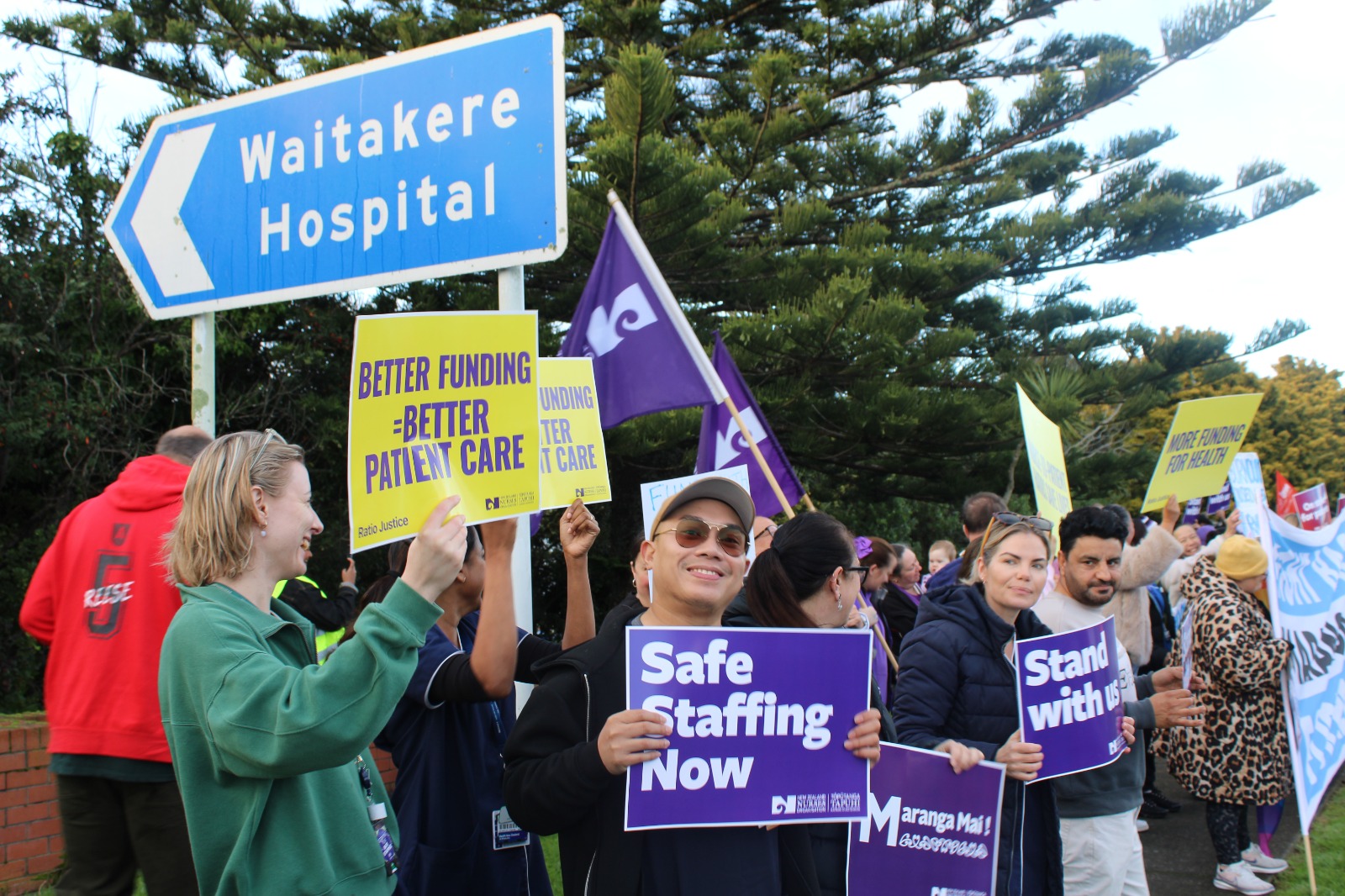
It followed a similar health and safety strike in Waitakere Hospital’s Muriwai ward in July.

NZNO nurses and health-care assistants (HCAs) walked off work for an hour after raising concerns since April 2025 — the ward becoming a focus for national concerns over understaffing.
Ahead of the strike, media reported on how a patient suffered a broken spine while the ward was short three HCAs.
This came after repeated warnings during the day about severe capacity issues.
‘Appropriate measures will be put in place’
An HNZ spokesperson said the Gisborne ED would remain open “and appropriate measures will be put in place to maintain patient and staff safety and provide service continuity”.
“Tairāwhiti is in an ongoing process looking at ED nursing staffing levels to ensure we have the right workforce capability, capacity and skill mix to deliver safe, high-quality patient care.”
There had been several opportunities for feedback throughout “and we remain committed to working in good faith as this process continues”.
The winter season had been a busy time for health services with a high number of patients with flu and respiratory illness. “August demand at Tairāwhiti has been very high combined with increased sick leave among clinical staff.”