


About the authors:Hannah Chittick, RN, MHSc, is programme leader for the bachelor of nursing at the Universal College of Learning (UCOL) Wairarapa, Masterton, New Zealand. Kathy Manhire, RN, RM, MMidwifery, IBCLC, is a principal academic staff member and co-ordinator of the Jennifer Roberts RN, MN, EdD (candidate), is a nursing policy advisor at the Nursing Council of New Zealand. This article was accepted for publication in August 2019. |
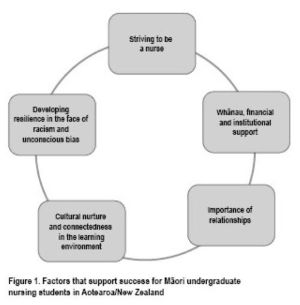
ABSTRACTAims: The aim of this study was to understand what factors help Māori succeed in bachelor of nursing education in Aotearoa/New Zealand, by examining the experiences of Māori graduate nurses. Background: Increasing the number of Māori in the health workforce has been identified as one of several key methods for improving Māori health outcomes. Previous research has identified several barriers that can affect Māori success in tertiary education. Knowledge of these barriers is important, to implement and maintain strategies to help Māori undergraduate nursing students succeed. Method: A qualitative descriptive study explored the perceptions of seven Māori bachelor of nursing graduates, through semi-structured face-to-face interviews in May/June 2017. Data were analysed using thematic methods to identify common themes. Results: Five themes were identified: Striving to be a nurse; whānau, financial and institutional support; importance of relationships; cultural nurture and connectedness in the learning environment; and developing resistance in the face of racism and unconscious bias. Conclusion: Key findings from the data and previous literature indicated that both tertiary education providers and clinical learning environments need to create teaching and learning environments that are more culturally appropriate for Māori. A commitment to providing these environments is required. More professional development to develop cultural competence among registered nurses in the current nursing workforce is also needed. |
||||
KEYWORDShealth workforce, qualitative, culturally appropriate, Māori, nursing education |
|||||
 Hannah Chittick
 Kathy Manhire
 Jennifer Roberts
INTRODUCTION
AOTEAROA/NEW ZEALAND WILL FACE face a nursing shortage within the next 10 to 15 years. The Nursing Council of New Zealand (Nursing Council) and the Ministry of Health (MOH) have stressed the need to produce more registered nurses (RNs) to meet future demand (MOH, 2016; Nursing Council, 2016). The proportion of non-Māori RNs in the nursing workforce far exceeds that of Māori RNs (Curtis, Wikaire, Stokes, & Reid, 2012a), who currently comprise approximately 7 percent of the nursing workforce, similar to the proportion of nurses of Filipino (8.6 percent) and Indian (7.4 percent) ethnicity (MOH, 2016; Nursing Council, 2017). International research also indicates that indigenous (and usually minority) ethnic groups are widely underrepresented in the health workforce (Loftin, Newman, Dumas, Gilden & Bond, 2012). Nuku (2015) states that Māori student enrolment numbers are disproportionately low, compared to non-Māori students, and that the number of Māori RNs in the nursing workforce needs to at least double to gain parity with the Māori proportion of the population, which is approximately 15 percent. Wilson, McKinney and Rapata-Hanning (2011) state that increasing the number of Māori RNs in the nursing workforce would have a positive effect on reducing the health disparities the Māori population experiences.
Potential and actual barriers to success for Māori nursing students must be understood to increase Māori enrolment numbers, retention and successful completion rates in bachelor of nursing education (Curtis et al, 2015; Foxall, 2013). Researchers have explored several barriers to success for Māori in tertiary education, and more specifically, nursing education. These included enrolment barriers, personal barriers, and cultural isolation, both in tertiary education providers and clinical learning environments (Southwick & Polaschek, 2014; Wilson et al, 2011). Māori nursing students have often said they faced racial discrimination and a lack of cultural awareness from both fellow students and staff in tertiary education. Some felt unwelcome in the classroom and that their cultural identity was not recognised or valued (Wikaire et al, 2017; Wilson et al, 2011). These experiences have also been reported by Māori new graduates in the workforce. Foxall (2013) found that Māori new graduates experienced racism towards both themselves and patients, which resulted in them feeling disempowered and uncomfortable with their cultural identity in the clinical work environment.
The aim of improving parity between the number of Māori RNs and the Māori population will not be successful unless tertiary education providers and clinical learning environments identify and implement successful strategies to improve enrolment, retention and successful completion of undergraduate nursing qualifications (Clendon, 2010; Nuku, 2015).
DESIGN AND METHODOLOGY
This research used a qualitative descriptive design. Sandelowski (2010) describes this design as providing an in-depth description of the participants’ perceptions or experiences, in as close a manner as possible to the original words used by the participants. Seven participants were recruited into the study by posting information on the research on tertiary education providers’ Facebook pages. All participants identified as Māori and had graduated within the last five years. Data were collected via face-to-face, semi-structured interviews, on a one-to-one basis. The duration of the interviews, which took place over a two-month period, ranged from 45 to 90 minutes. All interviews were audio-recorded using a digital recording device and transcribed. Transcriptions were sent to the participants to check.
ETHICAL CONSIDERATIONS
Ethical approval was obtained through the Eastern Institute of Technology’s (EIT) research ethics and approvals committee. The researcher identifies as Pākehā and therefore cultural supervision was important to ensure the research process remained culturally safe for the participants. Cultural supervision was provided by a research professor from the EIT research and innovation centre. This supervision provided the researcher with support in undertaking research with Māori participants, including tikanga in regard to recruitment, interviewing techniques and interpretation of the data from a Māori world view. The researcher was also a lecturer in a bachelor of nursing programme, so some participants were known to the researcher. Participants were previous graduates of the BN programme, so their vulnerability was limited. Participants were advised at the recruitment stage of the study, and throughout that they could leave the study at any time with no repercussion.
DATA ANALYSIS
Thematic analysis was used to find patterns and themes in the data (Braun & Clarke, 2006). The transcripts were read repeatedly, and audio recordings listened to, to draw out initial thoughts and ideas. Then codes were generated to help identify patterns in the data which could be grouped or coded. These groups or codes helped to identify important themes that related to the overall aim of the research (Braun & Clarke, 2006; Schneider & Whitehead, 2013). Finally, themes were reviewed thoroughly to ensure they were concise and accurate.
Research rigour
Rigour was ascertained by sharing the transcriptions, findings and discussion with the participants before the research was developed further and disseminated. Although the sample size was small, common responses from participants supported the reliability of the findings. Research supervisors were involved throughout the process, including review of the transcriptions, to ensure credibility of the data.
Due to the small sample size, the transferability of the findings is uncertain. However, the common themes that emerged from the data analysis, and the similarity with findings in previous literature support the usefulness of this study. The researcher’s personal interest was a motivating factor for undertaking this study. Therefore, personal bias must be acknowledged and recognised as a potential limitation.
FINDINGS AND DISCUSSION
The five themes that emerged are portrayed in Figure 1 (below).
Striving to be a nurse
The desire to become a nurse was evident among all the participants. Reasons for this career choice varied, including having past exposure to nurses as role models, and a desire to improve the quality of life for themselves and their whānau. One participant spoke of how she had been supported by nurses at the time of her mother’s death:
“I had always thought about nursing and nurses ’cause . . . when my mother died, I would look at nurses if I went to hospital . . . and saw them up on this pedestal, that they were helping people, and they were caring, almost like a substitute mother role.” (Participant 5 – P5)
Another motivation for some of the participants to enter nursing education was that they wanted and deserved better for themselves and their whānau:
“I didn’t want my kids to have the same upbringing that I did. We basically lived in poverty and we had nothing, we were definitely from a low socio-economic family. We didn’t have any role models in our family. So, when I had my first baby, I just didn’t want him to be brought up that way. Because I was stacking shelves for a few years, and I just knew that I didn’t want to do it [anymore]. And then my brother got unwell, and he said, ‘You have to do what you want to do.’ ” (P6)
A desire to increase the visibility of Māori in the health workforce, and to be a role model for other Māori, was a significant driver for many participants:
“From a Māori perspective, because of all the negativity and the lack of brown faces. Absolutely – that was my number one drive . . . was that it can be done. Don’t be turned away because of all the negativity. Its achievable! You just need to put your heart and soul into it really.” (P3).
Various levels of adversity were experienced by participants during their studies, and one participant spoke specifically about how this adversity pushed her to carry on:
“It can be done. Regardless of whatever obstacles that came up . . . I lost my nephew in the first week of year one to suicide. I wanted to stop . . . I wanted to just focus on my family, on my sister who was just going through hell; his younger brother who was just closed off to everyone. He didn’t want to talk to anybody. My young son who was his best friend . . . you know? There were all these things that were just telling me, ‘Just stop; do it next year’. But I . . . there was just something that was in there that was saying, ‘No, you can do this!’, you know? Life happens! And you just have to carry on. I just felt like I needed to prove that you can do it. To anyone . . . regardless of what happens.” (P3)
A range of factors motivated participants to want to become a nurse. There was a strong desire to be a positive role model to whānau. Becoming a nurse demonstrated success by making whānau members proud of their achievements, and the professional role they would hold in their communities as RNs. Participants recognised the importance of education and this strongly motivated them to enter the nursing profession. Wilson et al (2011) found that Māori often enter nursing education motivated by the opportunity to further their education and make a difference to Māori health. There was a strong sense of wanting better for their whānau and a desire for their children to have a different life than theirs. These beliefs have also been described as motivational in previous literature (Curtis et al, 2012a; Williams, 2011).
This study found that having the resilience to overcome obstacles was an important factor in achieving success. Individuals with resilience commonly share attributes – such as connectedness to family, friends and their social environments – that enable them to cope in difficult times (McAllister & McKinnon, 2009). The Ministry of Education (MOE) (2013) said that resilience enabled students to persevere through their studies, despite barriers they faced. Evidence suggests that in an educational context, resilience can be learned and improved. For learners to improve their resilience, learning environments need to be learner-centred, positive, demonstrate high expectations of learners, and support their social needs (McAllister & McKinnon, 2009). In this research, age and maturity were discussed as important factors that build resilience. While these are not factors that tertiary institutions can adjust, they need to be considered by institutions.
Whānau, financial and institutional support
Participants found there were various levels and types of support that helped them succeed. Many of the participants who had young families found their family responsibilities could present barriers to completion of their qualification. However, where whānau members provided essential support, this enabled the participants to continue their studies:
“My children and I bought a whare together . . . when I sat them down, I said, ‘This is what’s happening; this is what is going to happen and, financially, we’re going to have to support each other’, because I’ve always brought the money in, and it was good because they stepped up and they took over the finances of paying our mortgage; they realised there was times at night that I was tired; they cooked and cleaned, there were times I didn’t go to bed for 36 hours . . . but you’ve got to get your whānau on board.” (P7)
Scholarship opportunities were identified by the participants but they were often not clear about how to access this financial support:
“There are scholarships, but we are not told how to apply . . . so it’s like . . . [in] 500 words please explain how you doing this course is going to help towards Māori health. Well, you don’t know what you don’t know. So, if someone could help with the scholarships and explain how to apply for them, that might help a little bit as well.” (P5)
For a variety of reasons, participants felt that institutional support for Māori needed to be brought to Māori. These reasons included: being unaware of what support was available, feeling embarrassed, or not being clear how Māori support roles worked:
“I think perhaps what might have helped, maybe if the Māori liaison approached us individually and just told us what she was available for, what she could help with . . . I know she came to us as a class, and that was sort of like an introduction and the end, sort of thing. Perhaps she could have just touched base with a lot of Māori a bit more. I think that would have opened doorways . . . for people to approach her.” (P3)
These findings show that the kind of support dedicated to Māori needed to be made clear to students, and to be more targeted and individualised for Māori to use it to its potential.
This research showed that whānau support was instrumental to Māori nursing students’ success. Whānau support included financial assistance, help with childcare, providing encouragement and emotional support. Wilson et al (2011) and Williams (2011) found that to retain more Māori students in nursing/tertiary education, whānau need to be involved throughout students’ education. One participant in this research noted that for Māori to be successful, whānau need to be “on board”.
Williams (2011) also found that Māori students’ responsibilities to whānau may have an impact on their ability to successfully continue their education. Expectations on some Māori students to continue to provide childcare to children and grandchildren, to generate income, and to look after whānau presented difficulties that these students needed to navigate throughout their education (Williams, 2011; Wilson et al, 2011).
The importance of relationships
Positive and negative aspects of relationships either helped or hindered the participants’ experiences and success. They spoke about strong relationships they developed with lecturers over the course of the programme. One participant said lecturers building trust with their students was essential to their success, but that for Māori students, building that trust was not easy:
“Gaining Māori students’ confidence. Just to earn their [Māori students’] trust and then they’re willing to talk. Because if we don’t talk, we sink. We do. We need to be able to trust the person. If we’ve got someone we can confide in, and we can get support from, we can go really far, but I think we lack the trust aspect.” (P4)
Participants felt that being mentored by Māori nurses would provide another level of support, motivation and encouragement for students. This would encourage more Māori to undertake undergraduate nursing education, and would help Māori students understand the realities and complexities of being an RN. Although the strategy of involving Māori mentors in nursing education has been suggested earlier in the literature (Curtis et al, 2012a; Wilson et al, 2011), this study found no evidence of that mentorship in the nursing programme the participants had undertaken.
Several participants spoke of how they valued the support they received from some lecturers, in the form of moral support, helping to source financial assistance, or academic support. However, for Māori students to have open discussions with lecturers about their progress or any help they might need, trust needed to be developed between the lecturer and student. Bishop, Berryman, Cavanagh and Teddy (2009) found Māori had much better educational outcomes if they had positive relationships with their educators. Wilson et al (2011) identified institutional strategies including cultural support, which could include pōwhiri, Māori support groups, Māori mentorship and inclusion of whānau throughout students’ time in education. The importance of these supportive strategies was also identified by the participants in this study.
Relationships with preceptors on clinical placements were also discussed in this study. Some participants said they had worked alongside RNs who had made racist comments or displayed racist behaviour. This increased the students’ awareness of the power relationship that existed between students and RNs. Awareness and identification of potential power relationships is a key principle of culturally safe nursing practice (Nursing Council, 2011). Students are recipients of the RNs’ practice, therefore are entitled to culturally safe practice, just as patients and whānau members are. The actions and attitudes of some RNs, as described by the participants, demonstrated a lack of culturally safe nursing practice.
Cultural nurture and connectedness in the learning environment
Participants commented on the importance for Māori students of feeling culturally nurtured in the classroom. Some participants spoke of feeling marginalised, being only one of a few Māori in the classroom, and sometimes, the only Māori student.
“It did help to see another Māori face in the room . . . you kind of feel like, ‘Oh, I’m not just biting off more than what I can chew here.’ ” (P1)
Most of the participants also found the lack of Māori lecturers on the programme was a downside of nursing education at their institution.
Protection of culture in the learning environment was seen as important for success. Some participants described a need to feel culturally cherished, or to feel free to speak up as Māori in the classroom.
“The cultural nurture is what I really, really needed at that time, but I just didn’t feel safe and see, it’s easy [now] because I’m immersed in it . . . but now I’m looking back on it, I should have just put up my hand – but I just couldn’t at the time because I always had someone [Pākehā student] with me.” (P5)
Some of the participants acknowledged tikanga teaching practices that were used during their education, such as noho marae (staying on a marae), but felt these could have been delivered in a more culturally appropriate way:
“I know we had a noho marae day, but if we’d had the opportunity to go into the marae itself . . . and if I was given links into the iwi here . . . even the whole class, given the opportunity to make those links . . . so that if I thought that if they [Māori support staff] were not available and I wanted to go to that marae . . . just to get more nurture, I think I would have benefitted from that as well.” (P5)
Some participants raised pronunciation of te reo Māori as an issue in the classroom. Mispronunciation of common Māori words was seen as a negative experience:
“I sort of thought that people shouldn’t be teaching like the Treaty of Waitangi and saying all these Māori words if they can’t pronounce it properly. If you can’t pronounce it and if you don’t know enough about it . . . because someone would ask a question . . . and they’d read over what the slide just said. You know, like they didn’t know it properly.” (P6)
There were also mixed opinions about the delivery of Te Tiriti o Waitangi education in the classroom. One view was that a shared delivery of Te Tiriti o Waitangi content from both Māori and non-Māori lecturers would be beneficial to their learning:
“I think if you both did it [Te Tiriti o Waitangi] together so that you were with a Māori lecturer, because sometimes it is seen as Māori bashing . . . “Oh, yeah . . . here we go! God! Another one!” And this sounds terrible but if you’re presenting it together . . . to give it a little bit of credibility. Because if we come through and it is just Māori, people are just going to switch off. But with the two of you doing it together, it gives it . . . it makes it valid. But also, people are going to listen.” (P5)
The participants believed that if there were more Māori staff and students in their institutions, then students would feel more confident to speak up, particularly on issues relating to Māori health or te ao Māori (the Māori world-view). Wilson et al (2011) said having more Māori nursing role models both in and outside teaching faculty would uphold students’ cultural identity in the learning environment. Some tertiary institutions have recognised that they need to provide a more welcoming environment for Māori students and are working towards identifying and responding to those students’ needs. However, this is happening slowly. As institutions implement the strategies suggested by the participants in this study, nursing programmes will become more culturally responsive and more Māori may be motivated to enrol. Such changes could also aid the recruitment of Māori lecturers. The low ratio of Māori nursing lecturers to non-Māori lecturers may be due to the lower proportion of Māori RNs (Ngā Manukura o Āpōpō, 2014).
Cultural connectedness, both inside and outside the learning environment, increased participants’ self-confidence. This confidence could manifest as both feeling proud of being Māori, and not feeling ashamed, or feeling they had to defend their ethnicity and culture. Māori participants who felt a close connection with te ao Māori felt more confident in the classroom, particularly about topics directly relating to Māori and/or Māori health. This connectedness gave them the confidence to ask questions, or challenge lecturers and/or students if they felt that the discussions taking place about Māori were inaccurate. This confidence made individuals feel they had something to contribute in the classroom and confirmed their belief that they could succeed in the programme. These findings support a study by Stuart and Jose (2014), which looked at the well-being of Māori youth and the relationship between well-being and whanaungatanga. Their study found that if young Māori had a strong cultural connection, they were more likely to have an overall sense of well-being over longer periods of time.
Culturally appropriate delivery of tikanga in the learning environment, such as the experience of noho marae, classroom discussion of Te Tiriti o Waitangi, and correct pronunciation of te reo Māori, had a positive effect on the participants in this study. Studies by Wilson et al (2011) and Curtis et al (2012b) echo this, saying that Māori student success is strongly related to culturally safe and supportive learning environments. Participants said that learning experiences such as noho marae needed to be delivered in an authentic manner. If they just occurred in the usual classroom environment, it made the participants feel as though this experience was not considered important, which decreased their confidence in themselves and their tikanga. Ensuring that experiences such as noho marae are held on proper marae, including a pōwhiri, sharing of kai, the inclusion of appropriate Māori guest speakers, and possibly an overnight stay, make the experience more authentic, and give non-Māori students a positive experience and view of the Māori world.
Another recommendation from this study is that nursing lecturers should be encouraged to improve their pronunciation of te reo Māori. Participants found that mispronunciation of te reo Māori in the classroom had a negative effect on their learning. The Tertiary Education Union (TEU) has developed a policy to help TEPs introduce use of te reo Māori in their classrooms. As Te Tiriti o Waitangi makes clear, te reo Māori is a taonga, and needs to be protected and valued, both in society and in learning environments (TEU, 2014).
This study found that classroom education and discussion on Te Tiriti o Waitangi was not done well. Participants found that content was often brief and did not address all areas of Te Tiriti needed to gain a full understanding of its importance and its relationship to the health of all New Zealanders. Participants felt that some lecturers, particularly if they were non-Māori, did not have the knowledge to adequately educate students on important aspects of te Tiriti. They believed that delivery of this content should be done by both Māori and non-Māori lecturers, to gain knowledge from both perspectives.
Developing resistance in the face of racism
The participants described various experiences of racism during their nursing education. However, they also said that while these experiences were negative, they had developed resilience and resistance to combat the racism and discrimination, which they felt helped them succeed both during their education, and later in the nursing workforce. Participants described being involved in conversations with non-Māori students who had explicitly voiced their opinions about Māori in a negative manner:
“It was heavily talked about . . . the Māori faces on [the programme]. ‘Oh! One, two, three . . . Oh! You all made it! Yeah! Yay!’ It was . . . that . . . we made it into the quota. It did make it feel like I didn’t make it in on my own merits.” (P3)
This belief about Māori privilege was not just expressed within a tertiary institution. The same participant was involved in a discussion with an RN, while on clinical placement at her local district health board (DHB), who had similar views about Māori nurse employment outcomes:
“In the DHB, there’s a lot of entrenched old-school opinions about Māori health . . . and one [nurse] did say, ‘I bet all the Māori student nurses are going to get a job because they are Māori’. And I was like, ‘Oh my god’, so I just tried to shrink a little bit more, just not to get bullied.” (P5)
One participant explained how, in the clinical environment, she felt she needed to “stay humble” and not be seen to celebrate any achievements.
“I am a Māori nurse, and yes, I did get the NETP . . . so you know I tried . . . but, you can’t even celebrate . . . I did a little bit, but you’ve just got to stay really, really humble in case people try to say well, you are [privileged].” (P5)
Participants described situations where they demonstrated an ability to resist racist comments or biased views. Participants showed they had the confidence to teach others about te ao Māori and tikanga. P5 also described herself as a mentor for students in the clinical environment, demonstrating and role-modelling correct tikanga and pronunciation of te reo Māori, and resisting institutional racism:
“I try and help them [students] when it comes to culture, I take them under my wing . . . ‘Come on, this is how we do it’. I know there’s the three p’s . . . but there is so much more . . . that is just the start! But I stand up now, and help people say people’s names [correctly].” (P5)
The participants described strategies they employed as students that kept them safe on clinical placements. Some have taken these strategies with them into the workforce as new graduates, as they believed they faced the same judgmental attitudes there that they had faced as students. As the graduates developed a sense of confidence as RNs, they began to feel safe and more able to have a voice in the face of racism and unconscious bias.
This study has shown that racism exists in nursing education and practice. These instances of racism reported by the participants, both in the classroom, and in clinical practice, from both student peers and RNs, are concerning. The participants described how racist comments had a negative impact on their learning and confidence in the classroom. Discriminatory comments from non-Māori students and non-Māori RNs made students feel as though they did not deserve a place in nursing education or in the nursing workforce. It is important for all students, both Māori and non-Māori, to feel as though they are succeeding on their own merit, in their education or in their employment (Chauvel & Rean, 2012). Racism was also evident in a study by Wikaire et al (2017), which examined first-year Māori and Pacific students in a range of health degree programmes. Southwick and Polaschek (2014) say that although cultural safety has been taught in the nursing profession in Aotearoa/New Zealand since the 1990s, the focus remains on the cultural safety of patients and clients, when it should be widened to include interactions between nurses, to tackle institutional racism.
While some studies have explored factors that predict or support success for Māori in tertiary education, there is limited literature on how Māori define what makes them succeed (Chauvel & Rean, 2012). In this study, participants revealed what success meant to them: achieving goals, regardless of how long it took, or the obstacles faced along the way. The role of nursing lecturers was vitally important in helping students overcome these obstacles, such as by providing encouragement, showing belief in their ability, or helping them source financial assistance to continue their studies. It demonstrates that lecturing staff have a vital role to play in retaining Māori tertiary students through to completion of their qualifications (Curtis et al, 2012b; Sopoaga & van der Meer, 2012).
LIMITATIONS
This study reflects the views of a small sample of graduates from one tertiary education provider, therefore it is uncertain whether its findings would be replicated in other tertiary education providers across Aotearoa/New Zealand. While data saturation was achieved, the limited sample size may not provide generalisability of these findings.
CONCLUSION
This study has provided insights into the varied barriers and challenges that Māori face in nursing education in Aotearoa/New Zealand. While changes have been made in tertiary education and clinical learning environments to improve enrolment, retention and completion for Māori, large gaps in parity remain. The provision of more culturally appropriate learning environments, and an effort to increase the capability of RNs in cultural safety and competence is recommended. Further research examining perspectives across a range of providers could highlight further factors that could support Māori success in nursing education.
RECOMMENDATIONS
This study highlights several changes or improvements that tertiary education providers and clinical learning environments could implement to increase Māori enrolment in bachelor of nursing programmes, their retention in their studies and their successful completion of the course. Ensuring that teaching and learning environments are more culturally appropriate will have some positive effects on both enrolment numbers and retention rates over the course of the nursing programme.
These recommendations include:
- Increasing numbers of Māori lecturers on nursing programmes.
- Ensuring meaningful inclusion of tikanga practices in the curriculum, such as karakia, waiata, pōwhiri and noho marae.
- Providing accurate, comprehensive and culturally safe te Tiriti o Waitangi content throughout the programme. Nursing lecturers must have regular and high-quality professional development in this area.
- Improving nursing lecturers’ pronunciation of te reo Māori.
- Providing cultural competence education, in the form of regular professional development, for RNs – clinical learning workplaces must ensure that students’ learning environments are culturally appropriate and safe.
ACKNOWLEDGEMENT
The authors would like to acknowledge Dr David Tipene-Leach for his cultural supervision throughout the process of conducting this research and writing this article. Ngā mihi nui, David.
REFERENCES
Bishop, R., Berryman, M., Cavanagh, T., & Teddy, L. (2009). Te Kotahitanga: Addressing educational disparities facing Māori students in New Zealand. Teaching and Teacher Education, 25(5), 734-742.
Braun, V., & Clarke, V. (2006). Using thematic analysis in psychology. Qualitative Research in Psychology, 3(2), 77-101.
Chauvel, F., & Rean, J. (2012). Doing better for Māori in tertiary settings: Review of the literature. Tertiary Education Commission.
Clendon, J. (2010). Continuing health inequalities must be addressed. Kai Tiaki Nursing New Zealand, 16(11), 24-25.
Curtis, E., Wikaire, E., Stokes, K., & Reid, P. (2012a). Addressing indigenous health workforce inequities: A literature review exploring ‘best’ practice for recruitment into tertiary health programmes. International Journal for Equity in Health, 11(1), 13-16.
Curtis, E., Townsend, S., & Airini. (2012b). Improving indigenous and ethnic minority student success in foundation health study. Teaching in Higher Education, 17(5), 589-602.
Curtis, E., Wikaire, E., Jiang, Y., McMillan, L., Loto, R., & Reid, P. (2015). Quantitative analysis of a Māori and Pacific admission process on first-year health study. BMC Medical Education, 15(1), 196.
Foxall, D. (2013). Barriers in education of indigenous nursing students: A literature review. Nursing Praxis New Zealand, 29(3), 33-40.
Loftin, C., Newman, S. D., Dumas, B. P., Gilden, G., & Bond, M. L. (2012). Perceived barriers to success for minority nursing students: An integrative review. ISRN nursing, ID 806543.
McAllister, M., & McKinnon, J. (2009). The importance of teaching and learning resilience in the health disciplines: A critical review of the literature. Nurse Education Today, 29(4), 371-379.
Ministry of Education. (2013). Ka Hikitia: Accelerating success 2013–2017.
Ministry of Health. (2016a). Health of the health workforce 2015.
Ngā Manukura o āpōpō. (2014). The performance of New Zealand schools of nursing: Responsiveness to Māori nursing students – Scorecard 2014. Whangarei, New Zealand: Northland District Health Board.
Nuku, K. (2015). Building the Māori nursing workforce. Kai Tiaki Nursing New Zealand, 21(1), 31.
Nursing Council of New Zealand. (2011). Guidelines for cultural safety, the Treaty of Waitangi and Māori health in nursing education and practice.
Nursing Council of New Zealand. (2016). The 2005/06 and 2012/13 nursing cohorts report: 2016 edition.
Nursing Council of New Zealand. (2017). The New Zealand Nursing Workforce: A profile of Nurse Practitioners, Registered Nurses and Enrolled Nurses 2016¬2017.
Sandelowski, M. (2010). What’s in a name? Qualitative description revisited. Research in Nursing & Health, 33(1), 77-84.
Schneider, Z., & Whitehead, D. (2013). Nursing and midwifery research: Methods and appraisal for evidence-based practice (4th ed). Sydney, Australia: Elsevier Health Sciences.
Sopoaga, F., & van der Meer, J. (2012). Investigating factors that influence success of Pacific students in first-year health sciences at university in New Zealand. New Zealand Medical Journal, 125(1352), 28-38.
Southwick, M., & Polaschek, N. (2014). Reconstructing marginality: A new model of cultural diversity in nursing. Journal of Nursing Education, 53(5), 249-255.
Stuart, J., & Jose, P. E. (2014). The protective influence of family connectedness, ethnic identity, and ethnic engagement for New Zealand Māori adolescents. Developmental Psychology, 50(6), 1817-1826.
Tertiary Education Union. (2014). Te reo rangatira.
Wikaire, E., Curtis, E., Cormack, D., Jiang, Y., McMillan, L., Loto, R., & Reid, P. (2017). Predictors of academic success for Māori, Pacific and non-Māori non-Pacific students in health professional education: a quantitative analysis. Advances in Health Sciences Education, 22(2), 299-326.
Williams, T. (2011). “It’s about empowering the whānau”: Māori adult students succeeding at university. Waikato Journal of Education, 16(3), 57-68.
Wilson, D., McKinney, C., & Rapata-Hanning, M. (2011). Retention of indigenous nursing students in New Zealand: A cross-sectional survey. Contemporary Nurse, 38(1-2), 59-75.
Daily doses – uncut news
| 23 Oct |
National’s hiring freeze puts lives at riskLast night’s warnings from doctors at Wairau Hospital that patients may die if they don’t get more staff is yet another example of the damage National’s hiring freeze has done to our health system. |
| 23 Oct |
Recognition of need to fix primary care crisis good for patientsRecognition of the need to fix the crisis in primary health care is good for patients but stops short of a much-needed overhaul of the sector, NZNO says. |
| 20 Oct |
Winners of the 2026 NZ Primary Healthcare Awards | He Tohu Mauri Ora announced Over 600 supporters of primary care gathered at the Auckland's Viaduct Events Centre on Saturday night for a glittering gala dinner for the 2026 New Zealand Primary Healthcare Awards | He Tohu Mauri Ora.
|
| 19 Oct |
Te Whatu Ora must fully staff vital Starship Children's Hospital wardsTe Whatu Ora must fully staff all wards at Starship Children's Hospital including four vital wards which are short of a total of 18 full-time nurses, NZNO says. |
| 16 Oct |
Paid placements policy will help boost nursing workforceA policy to pay nursing students a weekly allowance while they're on clinical placements will help them graduate and boost Aotearoa New Zealand's homegrown nursing workforce, NZNO says. |
| 5 Oct |
Labour's pay rise a first step, but pay equity needs a full settlementTōpūtanga Tapuhi Kaitiaki o Aotearoa NZNO has welcomed Labour's promised pay rise for care and support workers as a first step. It says care and support workers now need a full settlement of their pay equity claim and a workable pay equity system for all of its members. |
| 1 Oct |
Health NZ releases first national report on serious adverse eventsHealth New Zealand has published its first national Serious Adverse Event Report, acknowledging the serious harm experienced by patients and whānau and outlining the improvements identified and actions underway to strengthen patient safety. The report covers serious adverse events reported in Hospital and Specialist Services between 1 July and 31 December 2025. |
| 25 Sept |
380 more health care workers at the end of winter too little too lateAn announcement of 380 additional nurses, midwives and health care assistants for hospitals around the country at the end of winter is too little too late, NZNO says. |
| 23 Sept |
Auckland University research finds nurse shortages increase post-surgery deaths and complicationsNew research by Auckland University has found addressing nurse shortages in post-operative care may save 182 lives a year because short-staffed wards have higher rates of potentially preventable deaths and complications after their surgeries. |
| 21 Sept |
Whanganui Hospital ED averaged 680% capacity over a week Working in an overcrowded emergency department (ED), up to 680% capacity over a week, makes staff feel overwhelmed with the pressure, Tōpūtanga Tapuhi Kaitiaki o Aotearoa NZNO says.
|
| 14 Sept |
WellSouth's Newborn Enrolment Kahu Taurima Programme a finalist at the Primary Care Awards 2026WellSouth's Newborn Enrolment Kahu Taurima Programme is a finalist at the Primary Care Awards for the HALEO Best Supplier Service, Product or Campaign category. Winners will be announced on 17 October. |
| 14 Sept |
Global Study: Nursing Shortages Require Workforce Policy Solutions, Not Recruitment Campaigns AloneWhy people choose nursing, and why they leave, comes down to the same factors. The global nursing shortage cannot be solved simply by encouraging more people to enter the profession, according to a new evidence brief. |
| 8 Sept |
Overworked, understaffed Gisborne ED staff strike Health and safety concerns arising from unsafe staffing levels have forced nurses at Gisborne Hospital’s emergency department (ED) to go on strike.
|
| 4 Sept |
Strong growth in wāhine Māori and Pacific women’s cervical screening rates highlights success of self-testing programmeCervical screening participation has increased significantly for both wāhine Māori and Pacific women, reflecting the strong impact of self-testing, Screening Services and the dedicated efforts of health providers working alongside their communities. |
| 4 Sept |
Government must adopt Wai 2713 recommendations on disability systemThe Coalition Government must urgently adopt new recommendations from the Waitangi Tribunal which has found significant parts of the disability system prejudice tāngata whaikaha Māori (Māori with disabilities), NZNO says. |
| 31 Aug |
Employing graduate nurses will help keep them in nursing and the countryA new proposal that will require Te Whatu Ora to offer all eligible graduate nurses jobs in the public health system will help keep them in nursing and in Aotearoa New Zealand, NZNO says. |
| 26 Aug |
Health Minister’s claim Winter Plan ‘managing well’ delusionalHealth Minister Simeon Brown’s claim that hospitals are ‘managing well’ because of the Government’s Winter Plan is delusional, NZNO says. |
| 25 Aug |
Hospital data shows nursing shortages continue to put patients at riskTe Whatu Ora data released today shows patients are continuing to be put at risk by the Coalition Government’s deliberate failure to safely staff hospital wards, NZNO says. |
| 24 Aug |
Fed-up North Shore ED staff declare state of emergencyNZNO members working in the emergency department (ED) at North Shore Hospital have declared a state of emergency due to unsafe staffing levels resulting in ongoing overcrowding. |
| 19 Aug |
What happened to the winter health plan?The $25 million 2026 Winter Plan launched by Health Minister Simeon Brown in March to erase pressure on the health system has been an unmitigated disaster, Tōpūtanga Tapuhi Kaitiaki o Aotearoa NZNO says. |
| 11 Aug |
Applications open for advanced nursing education programmesHealth New Zealand is encouraging registered nurses to apply for two advanced education programmes that support nurses to further develop their clinical skills and expand access to care in communities across New Zealand. |
| 3 Aug |
Health New Zealand welcomes settlement of NZRDA collective agreementHealth New Zealand welcomes the vote by New Zealand Resident Doctors Association (NZRDA) members to settle their collective agreement. |
| 30 Jul |
Backing our frontline rural health workforceRural communities across New Zealand will benefit from three new investments that will support the rural health workforce and help more people access care closer to home, Associate Health Minister Matt Doocey says. |
| 22 Jul |
Te Whatu Ora must disclose staffing levels at time of tragic deathTe Whatu Ora must disclose whether the Waikato emergency department (ED) was short-staffed at the time a man tragically died in the waiting room, NZNO says. |
| 6 Jul |
Reflecting on IND 2026Looking back on last month’s International Nurses Day 12 May 2026 (IND 2026), the impact of this year's theme "Our Nurses. Our Future. Empowered Nurses Save Lives" continues to resonate across the world. ICN’s landmark IND 2026 report defined seven key powers of nursing and this message has been strengthened with nurses in every region celebrating, naming, and owning their powers throughout May. |
| 3 Jul |
Health New Zealand acknowledges Ombudsman statement on Wakari Ward 10AHealth NZ welcomes the independent investigation by the Ministry of Health into Ward 10A. On Wednesday the Health NZ board agreed to close Wakari Ward 10a as a forensic intellectual disability (ID) unit, with the future use of the ward yet to be determined. |
| 2 Jul |
New programme to fast track bowel cancer care and cut colonoscopy waitlistsHealth New Zealand is today launching a national initiative, designed to fast track bowel cancer care and reduce colonoscopy waitlists by up to 30 per cent. |
| 1 Jul |
Six new Co-Response Team locations announced to strengthen support for people in mental distressThe next six locations for Health New Zealand and NZ Police Co-Response Teams have been confirmed, expanding a model that helps people experiencing mental distress receive timely, wraparound support that better meets their health needs. |
| 29 Jun |
Mental health and addiction targets progress continuesHealth New Zealand continues to make important progress against its mental health and addiction targets, meeting four out of five national targets this quarter. |
| 25 Jun |
Access to care continuing to improve across a range of health indicatorsNew health data released today shows continued improvement in access to care across a range of health indicators. |
| 18 Jun |
Funding "boost" continues dangerous under-funding of aged careThe Health Minister’s funding "boost" for aged residential care continues underfunding to the sector and will continue unsafe practices and short staffing, which is putting vulnerable residents at risk, NZNO says. |
| 16 Jun |
Labour to make maternity scans freeLabour will add free maternity scans to the Medicard alongside three free doctor’s visits a year, so every pregnant woman gets the care she needs. |